Showing posts with label writing. Show all posts

Monday, October 7, 2013

Strategies for the ACT English Test

 It’s that time of year again. College applications are flowing out of high school students and parents are getting nervous. testing is a huge part of the formula, so here are some suggestions and resources  to help keep nerves calm:

Barron’s ACT English, Reading, and Writing Workbook by Linda Carnevale gives college-bound students extensive practice and review that will help them excel on all three verbal sections and all four reading genres of the ACT. An introductory overview explains the formats for the English Test, the Reading Test, and the Writing Test. A full-length self-assessment test follows with an answer key and explanations to help students assess their strengths and weaknesses. Succeeding chapters review the subject matter of all three tests and present drills, strategies, practice questions, study advice, and test-taking tips. Students review English grammar, punctuation, and style. They sharpen their reading comprehension with practice passages in the Humanities, Natural Science, Prose Fiction, and Social Science. Finally, they hone their essay-writing skills, guided by the author’s instruction in organizing their ideas, writing a rough draft, and editing the finished essay. A final chapter presents a full-length practice test with answers and explanations.

The Grokit website says:

1. Think simple.  As far as the ACT is concerned, the best writing uses the fewest possible number of words to convey an idea.  This doesn’t always mean the shortest answer is the best answer–sometimes more words are needed in order for a phrase or sentence to be grammatically correct.  But in general avoid answer choices that seem wordy.  The best answers are concise and clear.

2. Take the whole sentence into account.  It’s easy to read just the underlined portion the question asks about, or maybe just the clause that the underlined portion is a part of.  However, many times the other clause or clauses in the sentence can affect your answer.  For example, if the other clause is an independent clause, you will need to make sure that the underlined portion does not create a comma splice with another independent clause.  Read the whole sentence to yourself and you will be less likely to overlook an error.


ACT English Scoring

Just like the other sections, the ACT English section can earn you between 1 and 36 points. This score will be averaged with the scores from the other multiple-choice sections (Math, Science Reasoning and Reading) to get you your Composite ACT score. You’ll also get a subscore for both the Usage/Mechanics and Rhetorical skills subcategories between 1 and 18. These subscores having nothing whatsoever to do with your overall score, and most colleges and universities will not care what your subscores are. Strange, but true. The average ACT English score is about a 21, but you’ll have to do much better than that if you’d like to hit up a top university for admissions acceptance – more like between a 30 and 34.  Source: About.com

 10 Tips for the ACT English Test

  1. Skim an English passage before starting work on the questions
  2. On questions that ask you to judge a passage, lean toward selecting a choice that favors it
  3. Choose answers that match the level of formality of the entire passage
  4. The best way to write something is the shortest correct way of writing it
  5. If you speak a “nonstandard” dialect, be extra careful with questions that focus on idioms
  6. Watch for subject-verb and noun-pronoun agreement
  7. Make sure parenthetical phrases begin and end with the same punctuation mark
  8. Look out for sentence fragments and run-on sentences
  9. Make sure that nouns and pronouns are modified by adjectives, and that verbs and adjectives are modified by adverbs
  10. Learn the difference between it’s and its
Source: Kaplan Test Prep

Michaelbrent Collings hopes someday to develop superpowers, and maybe get a cool robot arm

Our detailed discussions of children’s and young adult literature often include work that is traditionaly intended for adults, but is also accessible and useful for many young readers.
10560_214646002031443_650523458_nMichaelbrent Collings is a #1 bestselling novelist and screenwriter. His bestsellers include Strangers, Darkbound, Apparition, The Haunted, The Loon, and the YA fantasy series The Billy Saga (beginning with Billy: Messenger of Powers).

He hopes someday to develop superpowers, and maybe get a cool robot arm, his biography reads. 

Michaelbrent has a wife and several kids, all of whom are much better looking than he is (though he admits that’s a low bar to set), and much MUCH cooler than he is (also a low bar).

Here is an update from the author:
As with so many of my books, there are twists and turns throughout THE COLONY: RENEGADES. So please remember: reviews are great, but please don’t spoil the book for others by revealing the secrets!
1378451_10151776548333512_1453550173_nAlso, if you enjoy the book, please recommend it to a friend! The only way to keep your favorite authors working to bring you YOUR favorite books is not only to buy the book, but to encourage others to do so as well. Happy reading….
Michaelbrent  has a killer backhand on the badminton court (’cause he’s macho like that).

He published his first “paying” work – a short story for a local paper – at the age of 15. He won numerous awards and scholarships for creative writing while at college, and subsequently became the person who had more screenplays advance to quarterfinals and semifinals in the prestigious Nicholls Screenwriting competition in a single year than anyone else in the history of the competition.

His first produced script, Barricade, was made into a movie starring Eric McCormack of TV’s Will & Grace and Perception, and was released in 2012. Michaelbrent also wrote the screenplay for Darkroom, a movie starring Kaylee DeFer (Gossip Girl, Red State) and Elisabeth Rohm (Angel, Law & Order, Heroes). Darkroom is currently set for a 2013 release.

As a novelist, Michaelbrent has written numerous bestsellers, including Apparition, The Haunted, The Billy Saga, The Loon, Rising Fears, and others. In addition, he has also written dozens of non-fiction articles which have appeared in periodicals on several continents.

Michaelbrent is also a member of the WGA (Writers Guild of America) and the HWA (Horror Writers of America). In addition to selling, optioning, and doing rewrites on screenplays for major Hollywood production companies, he is currently developing several movies and television shows.

Michaelbrent is a frequent guest speaker at genre and literary conventions, high schools, church groups, and anywhere else that wants to talk about writing. If you’re interested in having him speak to your group, please contact him via the contact form on the bottom of the page. Michaelbrent also has a Facebook page at http://www.facebook.com/MichaelbrentCollings and can be followed on Twitter @mbcollings. You can follow him for cool news, updates, and advance notice of sales. You will also be kept safe when the Glorious Revolution begins!

Wednesday, September 25, 2013

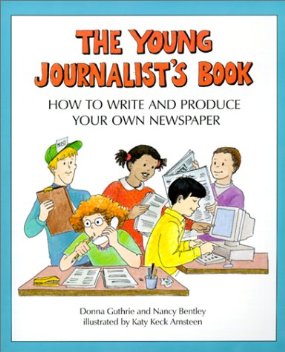
Young Journalist’s Book: How to Write and Produce Your Own Newspaper

CBS anchor Scott Pelley said at a speech at Quinnipiac University that journalists “are getting big stories wrong, over and over again,” as quoted by a commenter on The Idaho State Journal politics blog.
514J0T38H9L._SX285_Young Journalist’s Book: How to Write and Produce Your Own Newspaper, is a great place to help children begin learn the difference between good and bad journalism.
The book is a step-by-step guide that explains what a journalist does, what makes an interesting story, and how newspapers differ from books. Students learn about gathering facts, writing a story, proofreading, designing layout, printing, and distributing their newspaper. There are frequent references to using computers in the process. The authors describe the different types of stories, e.g., news, features, and editorials, with hints on how to write each one and suggestions for topics. This title is similar in format to Guthrie and Bentley’s The Young Author’s Do-It Yourself Book (1994) and The Young Producer’s Video Book (1995, both Millbrook). The full-color cartoons are appealing. Inspirational, practical fare for writers and would-be reporters.-Marion F. Gallivan, Gannon University, Erie, PA
E How talks about the steps to establishing a newspaper at your elementary school. They include:
Brainstorm possible newspaper names and story ideas with your newspaper staff. Articles can be about school-wide news, book reviews, movie reviews and more.

Assign articles to your students. Warn them about the dangers of plagiarism and explain the term to your students. Provide them with a deadline for their articles. Make the deadline reasonable. Since they are elementary school students, they will probably need at least a couple of weeks to complete their articles.

Decide whether you will type the articles into a word processing document or whether you will leave this task up to your staff. Some students know how to type quickly while others haven’t learned keyboarding yet. Be sure you run spell check and proofread the articles.

350 Fabulous Writing Prompts: Thought-Provoking Springboards For Creative, Expository, and Journal Writing

index350 Fabulous Writing Prompts: Thought-Provoking Springboards For Creative, Expository, and Journal Writing Paperback by Jacqueline Sweeney highlights creative, engaging, thought-provoking prompts for every day of the school year! More than 300 ways to motivate even your most reluctant writers. Topics include feelings, ethics, “imagineering,” quotations, humor, problem-solving, school situations, and so much more. For use with Grades 4-8.

Creative writing is any writing that goes outside the bounds of normal professional, journalistic, academic, or technical forms of literature, typically identified by an emphasis on narrative craft, character development, and the use of literary tropes. Due to the looseness of the definition, it is possible for writing such as feature stories to be considered creative writing, even though they fall under journalism, because the content of features is specifically focused on narrative and character development. Both fictional and non-fictional works fall into this category, including such forms as novels, biographies, short stories, and poems. In the academic setting, creative writing is typically separated into fiction and poetry classes, with a focus on writing in an original style, as opposed to imitating pre-existing genres such as crime or horror. Writing for the screen and stage—screenwriting and playwriting—are taught separately, but fit under the creative writing category as well.

Also consider Coming to Know by Nancy Atwell. This  book is for teachers who are ready to put writing to work across the curriculum. It is written by teachers of grades 3 through 6 who, dissatisfied with encyclopedia-based approaches to content-area writing, asked their students to write as scientists, historians, mathematicians, and literary critics do – to use writing-as-process to discover meaning.
One of the subjects of this volume is report writing and ways to help children produce content-area writing that is as personal and meaningful as their stories of their own experiences. Students learn how to take notes in their own words, conduct interviews, record observations, design their first simple research project, select appropriate genres for their research, and apply the techniques of writing workshop in science, social studies, and reading classes.

In addition, Coming to Know explores the uses of academic journals, or learning logs. Children speculate, brainstorm, role play, correspond, predict, and ask questions about math, reading, science, and social studies – and demonstrate the power of informal writing to generate thinking. Coming to Know is also about the connections between reading and writing, the effects of using writing to learn on curriculum and planning, and the role of children’s literature in teaching science, social studies and math.

Books by Michael Strickland That Celebrate the African American Experience

Families: Poems Celebrating the African American Experience

511KF9CYyBL._SY346_Family relationships are explored and affirmed in this joyful anthology of poems celebrating the diversity of African American families. Michael Strickland, has collaborated with his mother, noted educator Dorothy Strickland, to bring us this warm collection. Rich and powerful poems by Eloise Greenfield, Lucille Clifton, and others are rooted in deeply felt values of belonging and mutual respect.

From Publishers Weekly

Using works by Lucille Clifton, Nikki Giovanni, Langston Hughes and other African American poets, this determinedly upbeat collection focuses on happy childhood experiences-getting hugs and kisses, going on family outings and saying a tender good night. The poems selected are rarely representative of the poets’ best writing; moreover, they tend to stereotype pretty little girls and big strong boys. The larger problem, however, is that in “celebrating the African American experience,” the editors try to be both inclusive and exclusive at the same time. Little here suggests either the uniqueness or the variety of black culture; conversely, the Stricklands’ own initial poem extolling “all kinds of families” and poems that applaud children of “every color skin” seem at odds with the uniformly black faces Ward depicts in his acrylic paintings. But even though the focus is blurred, many teachers and parents will welcome the volume for its use of an African American cast in paying tribute to middle-class family values. Ages 5-8.
  • Age Range: 5 – 8 years
  • Grade Level: 2 – 3
  • Paperback: 32 pages
  • Publisher: Wordsong (February 1, 1996)
  • Language: English
  • ISBN-10: 1563975602
  • ISBN-13: 978-1563975608
  • Product Dimensions: 0.1 x 7.8 x 10.8 inches

From School Library Journal

Grade 2-5-A fine collection of 23 poems that feature African-American families. Youngsters’ voices come through vibrantly in these traditional and contemporary works that express the joy, sorrow, and excitement of childhood. Gwendolyn Brooks’s “Andre” is about a boy who dreams of having to choose new parents; Eloise Greenfield’s “Missing Mama” poignantly expresses a child’s sorrow at the death of his mother; and Lindamichellebaron’s “Hugs and Kisses” is a delightful selection about a boy’s hidden approval of his mother’s affection for him. Other poems are by Arnold Adoff, Lucille Clifton, Nikki Grimes, Nikki Giovanni, Langston Hughes, Naomi F. Faust, Julia Fields, and E. Alma Flagg. Black characters are depicted in the attractive acrylic illustrations, and some poems express themes directly related to African-American culture; however, the verses represent and impart universal feelings and moments, making this a book to be shared and enjoyed by all children.

Haircuts at Sleepy Sam’s

From Publishers Weekly

51QCGZY852L._SX260_Three brothers take a Saturday morning trip to Sam’s barber shop in this affable if slim story, narrated by the youngest sibling. Though their mother sends them with a note instructing the barber not to trim her sons’ Afro cuts too short on top, the boysAand SamAhave a different style in mind. Strickland, who has compiled several poetry anthologies for children, shapes credible dialogue and gives his narrative a bouncy cadence: awaiting their turn in the barber’s chair, the brothers “watch the men cut hair and talk, cut hair and joke, cut hair and argue, cut hair and laugh, cut hair and boogie to the oldies on the radio.” Holliday’s (First by Secondhand) 1970s’ palette underscores Mom’s old-fashioned ideas and the barbers’ banter about boxers Muhammad Ali and Joe Frazier. Rendered with airbrush and pastel chalk, his pictures showcase the animated expressions of the characters with close-to-photographic clarity against faded backgrounds of chartreuse, mauve and beige. Ages 4-8.
  • Age Range: 4 and up
  • Grade Level: Preschool and up
  • Hardcover: 32 pages
  • Publisher: Boyds Mills Press; 1st edition (September 1, 1998)
  • Language: English
  • ISBN-10: 1563975629
  • ISBN-13: 978-1563975622
  • Product Dimensions: 10.3 x 9.4 x 0.4 inches

From School Library Journal

Kindergarten-Grade 3-It’s Saturday morning and haircut time for three African-American brothers. While their mother insists on natural Afro cuts, the boys yearn for the contemporary shorter styles worn by their friends. Readers follow the children as they walk to Sam’s Barbershop where they give Sam the envelope from their mother that contains instructions and money for the haircuts. Three barbers work on the siblings and when they are finished, the boys have the haircuts they wanted. The pastel and airbrush illustrations lend a light, cheery tone and portray a lively community. The photographic quality of the facial expressions invites readers to join in the joking and horseplay at the barbershop. Both the first-person narrative and the illustrations reveal the close-knit relationships of the brothers and their surroundings. The text flows well and is a good choice for reading aloud. For similar books, see Margaree King Mitchell’s Uncle Jed’s Barbershop (S & S, 1993) and Natasha Tarpley’s I Love My Hair (Little, Brown, 1997).
Shawn Brommer, Southern Tier Library System, Painted Post, NY

African-American Writers: A Dictionary

A timely survey of an important sector of American letters, African American Writers, examines a multitude of black cultural leaders from the eighteenth century to the present as it focuses on novelists, essayists, scholars, activists, critics, teachers, poets, playwrights, and songwriters. Biographical information covers important events in a writer’s life, education, major works, honors and awards, family and important associates, and more. Includes illustrations, bibliography, and index.

From Library Journal

415372WY1YL._SY300_This unique title profiles several hundred African American fiction and nonfiction writers from Colonial times to the present. The table of contents lists the authors alphabetically and then divides them into 17 categories (novels, short stories, slave narratives, etc.) and nine themes (Folktales, the Harlem Renaissance, Trickster Tales, etc.); authors whose work spans several categories are listed separately under each. The profiles themselves, presented alphabetically and ranging from a paragraph for less well known writers like Ai Ogawa to three pages for writers like Ralph Ellison or Terry McMillan, are both biographical and critical, although the amount of criticism varies. Included in each entry are the writer’s birth and death dates, the categories into which he or she fits, and any pseudonyms. Black-and-white illustrations, references, genre lists, a comprehensive index, and chronologies of the writer’s life dates and of African American literary firsts complete this impressive title. Hatch, a freelance writer, and Strickland (creative writing, Boise State University.) are to be commended; no other single work seeks to include all past and present African American writers of significance in such an affordable format.
  • Series: Literary Companions (ABC)
  • Library Binding: 484 pages
  • Publisher: ABC-Clio Inc (June 1, 2000)
  • Language: English
  • ISBN-10: 0874369592
  • ISBN-13: 978-0874369595
  • Product Dimensions: 10.3 x 7.3 x 1.7 inches

From Booklist

Finding information about African American writers has always entailed searching in a variety of resources. Children\rquote s writers, political writers, poets, songwriters, novelists, and speechwriters are covered in different sources, some easy to find, others not. Information about some writers, such as Toni Morrison and Phillis Wheatley, is readily available. Information about other, more obscure writers, such as Abby Fisher, who authored the first published cookbook by an African American woman, is harder to locate. And unearthing facts about those who penned comic strips, compiled bibliographies, or wrote scripts or political columns is even more challenging.
This very complete and readable dictionary helps to meet that challenge. Spanning the entire history of African American expression, it covers more than 530 individuals, including writers of commercials, hymns, newspaper editorials, and rap songs along with screenplays, novels, autobiographies, essays, and poetry. Publishers, editors, and patrons of the arts are included as well. Entries vary from just a sentence for actor Laurence Fishburne to 10 pages for Richard Wright. A handful of important movements, publications, and genres (e.g., Harlem Renaissance, Negro Digest, Spirituals ) are also treated.
Each author entry begins with the author’s birth name, followed by pseudonyms or alternative names and birth and death dates if available, as well as the genres appropriate to the individual. In addition to biographical facts, the editors have included information about what inspired the authors to compose their works, in the hope that the volume would be a springboard for further investigation or even a source of ideas. Cross-references are in bold type, and each entry ends with abbreviated source references. The book is sprinkled with photographs and concludes with an appendix of writers by genre, a chronology of writers and a chronology of  firsts, full bibliographic references, and an index.

51V34KHK01L._SY346_The Club

… And

Shells Gold

Reading levels are inviting to reluctant readers.
- Each series features a multicultural cast of characters with strong group friendships.
- Engaging plots deal with peer rivalry, mystery, virtual reality, and much more!
The Club:
  • Age Range: 10 and up
  • Grade Level: 5 and up
  • Series: Summit Books
  • Paperback: 119 pages
  • Publisher: Perfection Learning (August 2002)
  • Language: English
  • ISBN-10: 0789155427
  • ISBN-13: 978-0789155429
  • Product Dimensions: 0.3 x 4.2 x 6.6 inches
From About.com:
51D47VDB53L._SY346_If you have kids or teens who are reluctant readers because they read below grade level and can’t find books they can read that interest them, try some of these hi-lo books. The Hi-Lo reading lists focus on books at the reader’s interest level (“Hi” stands for “high interest”) but written at a lower reading level (“Lo” stands for “low readability,” “low vocabulary,” “lower reading level”) to encourage reading. Kids and teens reading below grade level are more apt to want to read a book if it is not only at their reading level but also at their interest level.
  • Shell’s Gold:

  • Age Range: 10 and up
  • Grade Level: 5 and up
  • Series: Summit Books
  • Hardcover: 117 pages
  • Publisher: Perfection Learning (August 2002)
  • Language: English
  • ISBN-10: 0756908558
  • ISBN-13: 978-0756908553
A hi-lo book, broadly defined, is a title that offers highly interesting subject matter at a low reading level, according to Publisher’s Weekly. A number of publishers have focused on producing these books, though they often take slightly different approaches to creating the products that best fit a particular market. The abiding goal, says Arianne McHugh, president and co-owner of Saddleback Educational Publishing, “is to offer age-appropriate content—something that will grab [readers'] interest—at a readability level that is accessible.” As examples, McHugh notes that for a struggling reader in middle school or high school, although The Hunger Games would generate enormous interest, it would be a discouraging undertaking. On the other hand, “You can’t give them Clifford; we don’t want to embarrass them,” she says. Somewhere in the middle is the book that’s just right, she says.

African-American Poets (Collective Biographies)

51CtPUje71L._SY346_This book This book profiles the lives and work of ten African American poets: Gwendolyn Brooks, Haki R. Madhubuti, Rita Dove, Eloise Greenfield, Langston Hughes, Imamu Amiri Baraka, Maya Angelou, Paul Laurence Dunbar, Phillis Wheatley and Nikki Giovanni.
From School Library Journal:
Gr 7-12. ‘Ten African Americans are highlighted in these essays. Each 7-to-10 page sketch contains basic biographical information about the poet, showing how the African-American experience affected their work, along with a portrait (usually a photograph) and one of their poems. The writers range from former slave Phillis Wheatley to contemporary authors such as Maya Angelou, Eloise Greenfield, and Rita Dove. Also included are Langston Hughes, Gwendolyn Brooks, and Nikki Giovanni. The clear, focused writing makes this a solid choice for reports, especially in multicultural units.‘

Mastering Basic Grammar and Usage for the ACT

51IMsRplD4L._SY300_As you’ve probably already gathered, the English Test will never explicitly ask you to name a grammatical error, reads SparkNotes.  “But in order to identify and fix errors, you should know what they are. While you’ll often be able to rely on your ear to detect errors, many of the questions will ask you to fix phrases that are fine for spoken English but not for formal written English.”
***
The ACT test description states:
Spelling, vocabulary, and rote recall of rules of grammar aren’t tested. See sample questions or read tips and strategies.The test consists of five prose passages, each one accompanied by multiple-choice test questions. Different passage types are included to provide variety.
Some questions refer to underlined portions of the passage and offer several alternatives to the underlined portion. You must decide which choice is most appropriate in the context of the passage.
Some questions ask about an underlined portion, a section of the passage, or the passage as a whole. You must decide which choice best answers the question posed.
Many questions include “NO CHANGE” to the underlined portion or the passage as one of the choices.
The questions are numbered consecutively. Each question number corresponds to an underlined portion in the passage or to a box located in the passage.
Several  grammar issues, appear on the ACT English Test, including:
  1. Subject-Verb Agreement
  2. Pronoun-Antecedent Agreement
  3. Pronoun Cases
  4. Verb Tenses
  5. Adverbs and Adjectives
  6. Idioms
  7. Comparative and Superlative Modifiers
RECOMMENDED READING: Grammar Workbook for the SAT, ACT, and More, by George Ehrenhaft Ed.D.
A solid command of English grammar is a prerequisite for success when students take the SAT, ACT, and other college entrance tests. This workbook presents a detailed grammar review with dozens of practice quizzes and exercises to sharpen students’ skills. It begins with an explanation of grammatical terms and their functions. It then describes the 24 most common mistakes made by students and shows how to avoid them. Prominent among them are lack of agreement between subject and verb, misuse of pronouns, faulty parallel structure, and faulty punctuation. A final chapter focuses on advice and instruction for writing error-free SAT and ACT essays. This workbook is filled with sample questions exactly like those found on both the SAT and ACT, and comes with fully explained answers.
FURTHER RESOURCES:
Pronoun Case Quiz (Guide to Cases of Nouns and Pronouns with two quizzes) http://grammar.ccc.commnet.edu/grammar/cases.htm
Verb Tense Quiz: http://grammar.ccc.commnet.edu/grammar/quizzes/tenses/tenses_frame.html

Wednesday, August 21, 2013

Creative Writing Lesson Plan

“Perhaps then, someday in the future, you will gradually, without even noticing it, live your way into the answer. ” —Rainer Maria Riike, Letters To A Young Poet.

Welcome to Summer 2013 Creative Writing!

NOTE: YOU WILL SEE DOZENS OF ENTRIES ON THIS SITE ABOUT LITERATURE FOR YOUNG PEOPLE. ONLY THOSE WITH THE CATEGORY “Creative Writing Summer 2013″ ARE REQUIRED FOR THIS CLASS. THE REST ARE RECOMMENDED READING.

This video shows, as one commenter said, how “poetry (like all art) is subjective… I may like Disturbed, you may like Lady Ga Ga, he may like Jack Johnson, she may like Bethoven. None of it is wrong. It’s art. An expression that can not be measured except by how it moves you. (or doesn’t move you).”
_____
Be sure to review the syllabus for this class. It can be found by CLICKING HERE or by using this link: http://youngpeoplespavilion.com/summer-2013-creative-writing-syllabus/
A few important reminders:

* Check this website regularly for class updates and material. If you have a question such as: “I missed class, can you tell me what we did and what is due?” … this website is the spot to find your answer.
Recommended Reading:  Letters to a Young Poet, by Rainer Maria Rilke
Recommended Reading: Letters to a Young Poet, by
Rainer Maria Rilke

* Click on the “Creative Writing Summer 2013″ category below this post, and all class lesson plans (posted as of that date) will come up.

* This site will also be used for updates and announcements.
* Each class will include a 10 point “What I have learned in this class” assessment.
* All writing that will be graded must be submitted to me as a Microsoft Word Document. We will have time in class for you to transfer work from your flash drives.
* We have chosen certain texts that exemplify the craft of creative writing. If at any time a student/parent objects to any material used, I would be more than happy to accommodate by working together with all parties to choose an alternate text.
_____
In class today:
Class overview and syllabus review
Introductions
What is Poetry?
VIDEO: “O Captain! My Captain!” by Walt Whitman (See: Summer 2013 Creative Writing Videos)

Assessments:
1) What I have learned in this class  (10 points) Due by end of class period 6/10/13.
2) There will be a quiz on Literary and Poetry Terminology  (25 points). It will be short answer and multiple choice. Given in class Wednesday, 6/12/2013.
3)  FIRST WRITING ASSIGNMENT: Write your own poem: (50 points). Due Friday, 6/14, 2013. (See: Summer 2013 Creative Writing Assignments)
_____
What is poetry?
SOURCE: http://www.poetry.org/whatis.htm
Poetry (ancient Greek: ποιεω (poieo) = I create) is an art form in which human language is used for its aesthetic qualities in addition to, or instead of, its notional and semantic content. It consists largely of oral or literary works in which language is used in a manner that is felt by its user and audience to differ from ordinary prose.

It may use condensed or compressed form to convey emotion or ideas to the reader’s or listener’s mind or ear; it may also use devices such as assonance and repetition to achieve musical or incantatory effects. Poems frequently rely for their effect on imagery, word association, and the musical qualities of the language used. The interactive layering of all these effects to generate meaning is what marks poetry.
Because of its nature of emphasising linguistic form rather than using language purely for its content, poetry is notoriously difficult to translate from one language into another: a possible exception to this might be the Hebrew Psalms, where the beauty is found more in the balance of ideas than in specific vocabulary. In most poetry, it is the connotations and the “baggage” that words carry (the weight of words) that are most important. These shades and nuances of meaning can be difficult to interpret and can cause different readers to “hear” a particular piece of poetry differently. While there are reasonable interpretations, there can never be a definitive interpretation.

Click in this link http://www.poetry.org/whatis.htm to read more, including 

Nature of poetry

Sound in poetry

Poetry and form

Poetry and rhetoric

History of poetry

VIDEO: “Literary Devices” (See: Summer 2013 Creative Writing Videos)
TERMS:
1) figurative language
2) simile
3) metaphor
4) personification
5) hyperbole
6) alliteration
7) onomatopoeia
8) assonance
9) consonance
DEFINITIONS
1) communicates ideas beyond the ordinary, literal meaning of words
2) compares unrelated nouns, usually using the words “like” or “as”
3) an implied comparison that does not use the words like or as
4) giving human characteristics to inanimate objects, ideas, or animals
5) an exaggeration for the sake of emphasis, not to be taken literally
6) repetition of the initial letter or sound in two or more words in a line of verse
7) a word that represents or imitates natural sounds
8) the similarity or repetition of a vowel sound in two or more words
9) the repetition of final consonant sounds within a line of verse
HERE ARE A FEW EXAMPLES:
1)
  • Alright, the sky misses the sun at night.
  • Hear the mellow wedding bells. – Edgar Allen Poe
  • Out of reach, I pull out with a screech.
  • I move fast like a cheetah on the Serengeti.
  • Her head was spinning from all the new information.
  • The toast jumped out of the toaster.
  • I’m so hungry I could eat a horse.
  • The Sea lashed out in anger at the ships, unwilling to tolerate another battle.
  • The Redcoats are coming!
  • I’ve told you a million times to clean your room!
2)
 A Red, Red Rose
O My Luve’s like a red, red rose,
That’s newly sprung in June;
O My Luve’s like the melodie
That’s sweetly played in tune.
As fair art thou, my bonnie lass,
So deep in luve am I;
And I will luve thee still, my dear,
Till a’ the seas gang dry, my dear
While the sands o’ life shall run.
And fare thee weel, my only luve,
And fare thee weel, awhile!
And I will come again, my luve
Tho’ it ware ten thousand mile!

Robert Burns
1759-1796

Here are examples of  similie poems by Denise Rodgers:
Link: http://examples.yourdictionary.com/examples-of-simile-poems.html
3) One of the most prominent examples of a metaphor in English literature is the All the world’s a stage monologue from As You Like It:
All the world’s a stage,
And all the men and women merely players;
They have their exits and their entrances;William Shakespeare, As You Like It, 2/7[1]
This quote is a metaphor because the world is not literally a stage. By figuratively asserting that the world is a stage, Shakespeare uses the points of comparison between the world and a stage to convey an understanding about the mechanics of the world and the lives of the people within it.
_____
ThinkWave.com will be used for grading.

Michelle Witte: “Big Isn’t Always Better”

The following is an excerpt from a blog entry by Michelle is an author, editor, and literary agent Michelle Witte,  “Publishing is in flux,” Michelle writes.  “Anyone who pays attention to the industry knows that. But that isn’t necessarily a bad thing. With change comes opportunity, and some of the smaller independent publishers out there are in a prime position to innovate and try different strategies that the big guys don’t have the flexibility to do. So today I’d like to highlight some of the smaller publishers I see doing exciting things, and as I specialize in kidlit, these are all publishers of children’s or young adult books.”

Carolrhoda Lab

?????I’m a big fan of the deeply distinctive books that editorial director Andrew Karre selects for this YA imprint of Lerner books. Since his tastes run similar to mine—dark, quirky, weird, awesome—I’ve paid special attention to their offerings over the past few years. More than that, though, is Karre’s vision of what makes good literature for teens, and his ability to bring that out in writers. (Note: They don’t accept queries from unagented writers.)
Some of the most innovative titles in YA are coming from Carolrhoda Lab, including R.J. Anderson’s Ultraviolet, told from the perspective of a girl who feels colors and tastes words (an actual condition called Synesthesia), and that isn’t the weirdest aspect of the novel, by far. The imprint also published the US edition for one of my favorite books ever, Savannah Grey by Cliff McNish.
Read the full story here.
Follow Michelle on Facebook.

Saturday, August 17, 2013

Creative Writing: Four Genres in Brief: Lesson Plan

“Revising makes a person aware of how vast imagination is. One accesses something much larger than one’s self.” – Baron Wormser
This diary is my lesson plan for Monday, June 17 2013, for my 10th and 11th grade TRIO/Upward Bound Students.
All of my daily lesson plans for this summer can by found at: http://youngpeoplespavilion.com/category/creative-writing-summer-2013/

For the last week, we have read, reviewed, shared, analyzed, discussed and written about a wide variety of poems. We also drafted our first poem. My intention in including verse that ranged from Edgar Allen Poe’s work in the 1800s to modern slam poets in Brooklyn, New York can be expressed in one sentence.

We provided each other with an accessible survey of those technical aspects of poetry which students of creative writing often see as daunting.

We attempted to demystify the writing, experience and study of poetry, and explored the issues in a lively and informative fashion.
In effect, last week was a route map though the poetic maze, with discussion on such essential but often complex issues as rhythm and metre, the use of metaphor in poetry, poetic sound effects and the visual appearance of poetry. Our course aims to make the jargon of poetry less intimidating, offering clear explanations of poetic terminology allied to close readings. These pieces demonstrate how poetry actually works in practice. Our focus on short assignments in this class encourages students to work hard on revising each piece.
As we move into our short story unit this week, here are more thoughts on revision.

4141A66PuvL._SY300_According to Creative Writing: Four Genres in Brief, by David Starkey:
Although revision—the act of reconsidering and altering a piece of writing—may initially seem like a chore, most literary writers come to enjoy the process as much as, if not more than, the creation of the first draft. Indeed, finding yourself deep in a successful revision can become almost a mystical experience.
While editing and proofreading may take place in the revision process, those tasks are not what most teachers mean by “revision.” Editing means eliminating sentence-level errors. Proofreading is simply making a final pass through your draft to ensure that you haven’t left in any silly mistakes (“loose” for “lose,” “it’s” for “its,” and so on).
Revision in creative writing is a much larger process. It addresses global as much as local issues. A thorough revision of your story might mean reconceptualizing both the protagonist and the plot or deleting the first three paragraphs of your six-paragraph essay.
“The revision process involves comparing an existing text to a writer’s goals or ideal text, diagnosing the differences, and deciding how to reduce or remove these differences to bring the text as close as possible to the desired status,” wrote Todd Lubart. Georgia Heard likes to reminds writers that “revision doesn’t necessarily take place after they’ve finished a piece of writing, but instead . . . will most likely occur throughout the writing process.”

In an essay comparing the composing strategies of student writers and experienced adult writers, Nancy Sommers notes that “experienced writers describe their primary objective when revising as finding the form or shape of their argument.” Sommers goes on to remark that experienced writers believe that “their first drafts are usually scattered attempts to define their territory,” while the goal of second drafts “is to begin observing general patterns of development.

This week, you will write a short story. My approach to teaching this genre is to let plot guide your writing.
According to Writer’s Digest:
The short story is the art of abbreviation. We aren’t dealing with the panorama of life as we might be in a novel. We’re focused. If the novel is the art of the gaze, the short story is the art of the glance. The short story’s illumination must be sudden and should suggest an ongoing life, not present it in full. A short story must immediately pull the reader out of her world and drop her into the world of the story. There’s little time for setup. We begin when everything but the action is over—at the edge of the cliff. …If crafting such an engaging world in so few words seems intimidating, begin by grounding yourself in the fundamentals of good storytelling. We read stories to make sense of our lives, to be entertained, and to feel something. We read them to be transported to another more lucid and compelling world, to learn about ourselves, what it’s like to be human, and to “meet” someone we can care about. We read stories in order to imagine and to create, and so we ask the writer to tell us a story. And when we say story, we mean plot.

Plots, Aristotle told us, have beginnings, middles and ends, and they proceed through a series of reversals and recognitions, a reversal being a shift in a situation to its opposite, and a recognition being a change from ignorance to awareness. The basic plot of every story—regardless of length or complexity—is: A central character wants something intensely, goes after it despite opposition and, as a result of a struggle, comes to either win or lose. … Many aspiring short-story writers shun plot and instead focus on the other elements that make up a snapshot of a story—characters, descriptions, setting and the like. But no matter how luminous your prose or how fascinating your characters, if you have no plot—no narrative shape—if the characters have nothing meaningful to accomplish, the reader will lose interest in even a short piece. Plot is your weapon of suspense. Wield it wisely, and the reader will want to know what happens next.
So in crafting our  short stories, we will begin by taking our definition of plot and letting it guide us, quite naturally, to considerations of characterization, theme, tone, point of view, setting and so on. This approach can guide you in composing a short story that creates the emotional and intellectual experience your reader hopes for.
Sometimes when I think how good my book can be, I can hardly breathe. Truman Capote
We will use the following Short Story Worksheet to engage and discuss stories this week.
SOURCE: http://readlearnwrite.com/how-to-dissect-a-short-story-free-short-story-worksheet-included/
1. Who is the main character?
2. What is that character’s desire or decision? What do they want? What do they do to get it?
3. Who or what comes in conflict with the main character? How does that person, place, or thing work to frustrate the main character’s desire or decision?
4. How does the main character change? How is he/she transformed by his/her desire or decision and the associated conflict?
5. Does the character succeed or fail?
6. How does the author open the story?
7. How does the author introduce the main character?
8. What is the story’s mood?
9. How does the story end?
10. What tense is the story told in?
The Writer’s Tools: Cite an example of the author’s use of Action, Dialogue, Description, Inner Monologue, and Exposition/Narrative.
1. Action.
2. Dialogue.
3. Description.
4. Inner Monologue.
5. Exposition / Narrative.
_______________
Sample Short Stories:
How the Leopard Got His Spots by Rudyard Kipling (1865-1936)
And we will be examining Tarzan by Edgar Rice Burroughs
Elements of short story can be found in many of the television shows that you regularly watch, such as Glee:
http://www.fox.com/glee/full-episodes/29303875611/

What Makes a Good Poem? Creative Writing Lesson Plan

Recommended Reading: Writing Poetry from the Inside Out: Finding Your Voice Through the Craft of Poetry, by Sandford Lyne

Recommended Reading: Writing Poetry from the Inside Out: Finding Your Voice Through the Craft of Poetry, by Sandford Lyne

As we begin to look at our poems in more depth, here are some of the rubrics and ideas we will be using:
What makes a good poem? – Short Poems
What is Good Poetry (What Makes Good Poetry)? – PoetrySoup
What Makes a Good Poem? – Marilyn Singer
How to Critique Poetry: 9 Steps – wikiHow
How to Critique a Poem | eHow
and  How to critique a poem | ebooks4writers
Further, here are some thoughts from: Telling a Good Poem from a Bad One – Daily Writing Tips:

What makes a poem “good”?

The answer ultimately lies with the reader of the poem, but there is a certain consensus as to what makes a poem “good” or “bad.”
According to the critic Coleridge, prose is “words in their best order,” while poetry is “the best words in their best order.

Poetry demands precision. The novelist can get away with less than precise expression from time to time because the story will pull the reader along. The job of the poet is to create a picture in the mind and an emotion in the heart. Every single word counts. The wrong choice–a word with the wrong connotation or the wrong number of syllables or an unlovely combination of consonant sounds–spoils all.
The underlying thought of the poem is also important. Some poems are written to create a picture only, but the most memorable poems also convey a universal truth about the human condition. For me, a “good” poem leaves me with goosebumps along my arms. I think a poem is “bad” when it lacks a discernible point and sounds like prose.

In Writing Poetry from the Inside Out: Finding Your Voice Through the Craft of Poetry, poet and national poetry workshop leader, Sandford Lyne, offers the writing exercises, guidance, and encouragement you need to find the poet inside you. Lyne’s techniques, which he developed through twenty years of teaching poetry workshops, flow from an understanding that poetry is an art form open to everyone. We all can-and should-write poetry.

In this enchanting and inspiring volume, Lyne will introduce you to the pleasures and surprises of writing poetry, and his methods and insights will help you tap into your own unique voice and perspective to compose poems of your own in as little as a few minutes.

Whether you are an experienced writer looking for new techniques and sources of inspiration or a novice poet who has never written a poem in your life, Writing Poetry from the Inside Out will help you to craft the poems you’ve always longed to write.

Nana’s Gift offers a timeless message about intergenerational family relationships

Nana’s Gift is a heartwarming, touching, and beautifully written picture book by Agy Wilson, Darlee Sims is left at Nana’s for the weekend and at first is not happy with it. But having fun with Nana, Pasha and Honey, Darlee learns about her family, and best of all herself. With wonderful illustrations that have a hand-drawn look, Nana’s Gift offers a timeless message about intergenerational family relationships.
Nana's Gift  Agy Wilson cover

With the ever increasing older population, it is important for children to learn to appreciate contributions to our society by older people, writes Karen Debord in Selecting Children’s Books with Positive Intergenerational Messages.
Storybooks can be one vehicle to breaking stereotypes about aging. Using books to portray ideas is an excellent exercise in literacy but also helps children construct their knowledge of how they fit into the larger world. The difficulty for teachers is in keeping up with current titles that portray accurate and positive images of today’s society.
*****
Here is a look inside the book:
nana's_gift_7In her article, Debord suggests we pay attention to the following considerations when selecting good books to use with children:
realistic and believable portrayal of characters
a story that chronologically unfolds
a resolution of tension or conflict
simple plot to allow the child to become involved in the action, discovering the problem and understanding the resolution
a theme that relates to children’s understanding, needs and interests.
style that involves rhythm, repetition and a careful choice of words
portrayal of a diversity of culture, community and lacks stereotypes
characters are engaged in a variety of activities
“I love family, art, environment, history, calligraphy and all things language,” writes Wilson. “It’s only natural for me throw it into a huge pot and cook up my books. When I’m not playing with kids or pets, I’m usually immersing myself in my work.”
Bridge the generation gap with titles like this one that portray positive relationships between the old and young — sure to spark discussion.

Four Twitter ideas for teaching concise writing, a FREE Ebook and other resources

51o5ZOaJwdLHere are some activities that I will use in my 10th and 11th grade creative writing class this summer for TRIO/Upward Bound.

The strategies  teach concise writing and are based on Twitter. However, the ideas can easily be adapted for other platforms including Facebook status updates or text messages.

SOURCE: Less Is More: Using Social Media to Inspire Concise Writing
1) Personal Writing: Students write a series of Twitter-esque personal “essays” (140 characters maximum, including spaces and punctuation). Topic ideas include the school year, life lessons, relationships and personal goals. Each one can be stand-alone, or each post can be part of a series. They might do this, for example, for personal writing or in the context of developing college essay ideas. They then develop one or more selected posts into a longer piece. Afterward, debrief: How did starting off by writing brief expressions of their ideas contribute to their writing process?
WRITE GOOD OR DIE IS A FREE EBOOK that gives survival tips for 21st century writers, from best-selling authors Kevin J. Anderson, M.J. Rose, Heather Graham, J.A. Konrath, Gayle Lynds, Alexandra Sokoloff, Jonathan Maberry, and more. How to develop your craft, improve your writing, get an agent, promote your work, embrace the digital age, and prepare yourself for the coming changes in the publishing industry. Edited by Scott Nicholson. Other contributors include Elizabeth Massie, Harley Jane Kozak, Douglas Clegg, Brandon Massey, Mur Lafferty, Dean Wesley Smith, David J. Montgomery, Kristine Kathryn Rusch, Robert Kroese, and Adrienne Jones. Covering art, craft, and business. All proceeds benefit the non-profit organization Literacy Inc., which promotes reading among teens.
2) Authentic Writing: Taking a page from Andy Selsberg, students find ways to contribute meaningfully and authentically to the world of the Web. Ideas include, as Mr. Selsberg suggests, writing descriptions to “sell” an item of used clothing on eBay, commenting on a YouTube video or contributing a product review on a site like Amazon, as well as participating in our daily Student Opinion discussions. Establish guidelines for good Web citizenship. Have students read each other’s posts and provide helpful feedback. How was this activity different from writing academic essays that only the teacher reads?

3) Poetry: Students read the Twitter poems by Billy Collins, Claudia Rankine, Elizabeth Alexander and Robert Pinsky. They then write their own original “Twitter poems” or rewrite a classic poem or one of their own poems in 140 characters or fewer. They can also look further into the history and impact of brief poems, like Ezra Pound’s “In a Station of the Metro” and William Carlos Williams’s “So Much Depends.”

4) Creative Writing: Students write pieces inspired by so-called Twitter novels and cellphone novels, either by writing the equivalent of an original story or novella 140 characters at a time, or by “crowd-sourcing” the work, by having each student contribute a line, in turn, to a class novel.
_______