Showing posts with label science. Show all posts

Monday, October 7, 2013

Strategies for the ACT English Test

 It’s that time of year again. College applications are flowing out of high school students and parents are getting nervous. testing is a huge part of the formula, so here are some suggestions and resources  to help keep nerves calm:

Barron’s ACT English, Reading, and Writing Workbook by Linda Carnevale gives college-bound students extensive practice and review that will help them excel on all three verbal sections and all four reading genres of the ACT. An introductory overview explains the formats for the English Test, the Reading Test, and the Writing Test. A full-length self-assessment test follows with an answer key and explanations to help students assess their strengths and weaknesses. Succeeding chapters review the subject matter of all three tests and present drills, strategies, practice questions, study advice, and test-taking tips. Students review English grammar, punctuation, and style. They sharpen their reading comprehension with practice passages in the Humanities, Natural Science, Prose Fiction, and Social Science. Finally, they hone their essay-writing skills, guided by the author’s instruction in organizing their ideas, writing a rough draft, and editing the finished essay. A final chapter presents a full-length practice test with answers and explanations.

The Grokit website says:

1. Think simple.  As far as the ACT is concerned, the best writing uses the fewest possible number of words to convey an idea.  This doesn’t always mean the shortest answer is the best answer–sometimes more words are needed in order for a phrase or sentence to be grammatically correct.  But in general avoid answer choices that seem wordy.  The best answers are concise and clear.

2. Take the whole sentence into account.  It’s easy to read just the underlined portion the question asks about, or maybe just the clause that the underlined portion is a part of.  However, many times the other clause or clauses in the sentence can affect your answer.  For example, if the other clause is an independent clause, you will need to make sure that the underlined portion does not create a comma splice with another independent clause.  Read the whole sentence to yourself and you will be less likely to overlook an error.


ACT English Scoring

Just like the other sections, the ACT English section can earn you between 1 and 36 points. This score will be averaged with the scores from the other multiple-choice sections (Math, Science Reasoning and Reading) to get you your Composite ACT score. You’ll also get a subscore for both the Usage/Mechanics and Rhetorical skills subcategories between 1 and 18. These subscores having nothing whatsoever to do with your overall score, and most colleges and universities will not care what your subscores are. Strange, but true. The average ACT English score is about a 21, but you’ll have to do much better than that if you’d like to hit up a top university for admissions acceptance – more like between a 30 and 34.  Source: About.com

 10 Tips for the ACT English Test

  1. Skim an English passage before starting work on the questions
  2. On questions that ask you to judge a passage, lean toward selecting a choice that favors it
  3. Choose answers that match the level of formality of the entire passage
  4. The best way to write something is the shortest correct way of writing it
  5. If you speak a “nonstandard” dialect, be extra careful with questions that focus on idioms
  6. Watch for subject-verb and noun-pronoun agreement
  7. Make sure parenthetical phrases begin and end with the same punctuation mark
  8. Look out for sentence fragments and run-on sentences
  9. Make sure that nouns and pronouns are modified by adjectives, and that verbs and adjectives are modified by adverbs
  10. Learn the difference between it’s and its
Source: Kaplan Test Prep

Wednesday, September 25, 2013

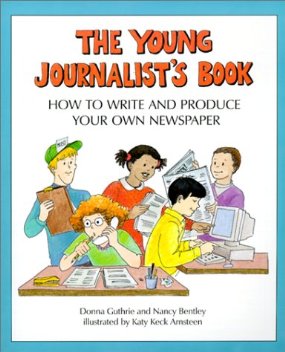
Young Journalist’s Book: How to Write and Produce Your Own Newspaper

CBS anchor Scott Pelley said at a speech at Quinnipiac University that journalists “are getting big stories wrong, over and over again,” as quoted by a commenter on The Idaho State Journal politics blog.
514J0T38H9L._SX285_Young Journalist’s Book: How to Write and Produce Your Own Newspaper, is a great place to help children begin learn the difference between good and bad journalism.
The book is a step-by-step guide that explains what a journalist does, what makes an interesting story, and how newspapers differ from books. Students learn about gathering facts, writing a story, proofreading, designing layout, printing, and distributing their newspaper. There are frequent references to using computers in the process. The authors describe the different types of stories, e.g., news, features, and editorials, with hints on how to write each one and suggestions for topics. This title is similar in format to Guthrie and Bentley’s The Young Author’s Do-It Yourself Book (1994) and The Young Producer’s Video Book (1995, both Millbrook). The full-color cartoons are appealing. Inspirational, practical fare for writers and would-be reporters.-Marion F. Gallivan, Gannon University, Erie, PA
E How talks about the steps to establishing a newspaper at your elementary school. They include:
Brainstorm possible newspaper names and story ideas with your newspaper staff. Articles can be about school-wide news, book reviews, movie reviews and more.

Assign articles to your students. Warn them about the dangers of plagiarism and explain the term to your students. Provide them with a deadline for their articles. Make the deadline reasonable. Since they are elementary school students, they will probably need at least a couple of weeks to complete their articles.

Decide whether you will type the articles into a word processing document or whether you will leave this task up to your staff. Some students know how to type quickly while others haven’t learned keyboarding yet. Be sure you run spell check and proofread the articles.

Saturday, August 17, 2013

The Common Core: Teaching K-5 Students to Meet the Reading Standards

Click on the image to read more
This essential resource, The Common Core: Teaching K-5 Students to Meet the Reading Standards,  explains the key points of the CCSS reading standards, then aligns each Standard with appropriate research-based strategies, and shows you how to use those strategies to teach your students. Classroom applications and student examples will make this your go to CCSS resource.
The International Reading Association is the world’s premier organization of literacy professionals. Our titles promote reading by providing professional development to continuously advance the quality of literacy instruction and research.

Research-based, classroom-tested, and peer-reviewed, IRA titles are among the highest quality tools that help literacy professionals do their jobs better.

RELATED READING:  Teaching the Common Core Math Standards with Hands-On Activities, Grades 6-8
Helpful advice for teaching Common Core Math Standards to middle-school studentsThe new Common Core State Standards for Mathematics have been formulated to provide students with instruction that will help them acquire a thorough knowledge of math at their grade level, which will in turn enable them to move on to higher mathematics with competence and confidence. Hands-on Activities for Teaching the Common Core Math Standards is designed to help teachers instruct their students so that they will better understand and apply the skills outlined in the Standards. This important resource also gives teachers a wealth of tools and activities that can encourage students to think critically, use mathematical reasoning, and employ various problem-solving strategies.
  • Filled with activities that will help students gain an understanding of math concepts and skills correlated to the Common Core State Math Standards
  • Offers guidance for helping students apply their understanding of math concepts and skills, develop proficiency in calculations, and learn to think abstractly
  • Describes ways to get students to collaborate with other students, utilize technology, communicate ideas about math both orally and in writing, and gain an appreciation of the significance of mathematics to real life
This practical and easy-to-use resource will help teachers give students the foundation they need for success in higher mathematics.

Click on image to read more

Click on image to read more
Some of the many areas by this series of books addressed include:
-Comprehension
-Response To Intervention/Struggling Readers
-Early Literacy
-Adolescent Literacy
-Assessment
-Literacy Coaching
-Research And Policy
An amazon review said:
As a reading specialist and a member of the ELA Common Core committee for grades 5-6, I am looking for more information and resources to help roll out Common Core. This resource gives a detailed explanation of CC, and a breakdown of the skills the students need to master by the end of the year as well as activities and strategies to use in the classroom for each of the strategies. It also gives you plenty of ideas to incorporate some of the other CC standards so that you are not just teaching one standard but a number of them. I can’t wait for the grade 6-12 edition to come out! I have purchased a number of resources and none of them come close to containing the information and suggestions that this one does. Common Core is hard enough to wrap your mind around but I have a much clearer idea of what it is now and what we need to incorporate and how to do it! It truly is a must have.

Four Twitter ideas for teaching concise writing, a FREE Ebook and other resources

51o5ZOaJwdLHere are some activities that I will use in my 10th and 11th grade creative writing class this summer for TRIO/Upward Bound.

The strategies  teach concise writing and are based on Twitter. However, the ideas can easily be adapted for other platforms including Facebook status updates or text messages.

SOURCE: Less Is More: Using Social Media to Inspire Concise Writing
1) Personal Writing: Students write a series of Twitter-esque personal “essays” (140 characters maximum, including spaces and punctuation). Topic ideas include the school year, life lessons, relationships and personal goals. Each one can be stand-alone, or each post can be part of a series. They might do this, for example, for personal writing or in the context of developing college essay ideas. They then develop one or more selected posts into a longer piece. Afterward, debrief: How did starting off by writing brief expressions of their ideas contribute to their writing process?
WRITE GOOD OR DIE IS A FREE EBOOK that gives survival tips for 21st century writers, from best-selling authors Kevin J. Anderson, M.J. Rose, Heather Graham, J.A. Konrath, Gayle Lynds, Alexandra Sokoloff, Jonathan Maberry, and more. How to develop your craft, improve your writing, get an agent, promote your work, embrace the digital age, and prepare yourself for the coming changes in the publishing industry. Edited by Scott Nicholson. Other contributors include Elizabeth Massie, Harley Jane Kozak, Douglas Clegg, Brandon Massey, Mur Lafferty, Dean Wesley Smith, David J. Montgomery, Kristine Kathryn Rusch, Robert Kroese, and Adrienne Jones. Covering art, craft, and business. All proceeds benefit the non-profit organization Literacy Inc., which promotes reading among teens.
2) Authentic Writing: Taking a page from Andy Selsberg, students find ways to contribute meaningfully and authentically to the world of the Web. Ideas include, as Mr. Selsberg suggests, writing descriptions to “sell” an item of used clothing on eBay, commenting on a YouTube video or contributing a product review on a site like Amazon, as well as participating in our daily Student Opinion discussions. Establish guidelines for good Web citizenship. Have students read each other’s posts and provide helpful feedback. How was this activity different from writing academic essays that only the teacher reads?

3) Poetry: Students read the Twitter poems by Billy Collins, Claudia Rankine, Elizabeth Alexander and Robert Pinsky. They then write their own original “Twitter poems” or rewrite a classic poem or one of their own poems in 140 characters or fewer. They can also look further into the history and impact of brief poems, like Ezra Pound’s “In a Station of the Metro” and William Carlos Williams’s “So Much Depends.”

4) Creative Writing: Students write pieces inspired by so-called Twitter novels and cellphone novels, either by writing the equivalent of an original story or novella 140 characters at a time, or by “crowd-sourcing” the work, by having each student contribute a line, in turn, to a class novel.
_______