Showing posts with label Children's Literature. Show all posts

Wednesday, September 25, 2013

Children’s Books that Build Character

GreenEggsHam1A column called A bicycle for a little girl had me thinking about its connections to children’s literature, reading and learning.
“Aren’t you the little girl who is always in here looking at bikes?” Emily nodded. “Is this going to be your bike?” Again she nodded. He smiled and turned to me, “You know, the shop ain’t that busy right now. You just pay for half of them, I’ll donate the other half, and I’ll fix it up for free.”
I nodded my agreement, and Emily ran to him and gave him a big hug. The old man smiled. “I’d say a hug is darned good pay.”

I paid my part, and a few days later we took Emily to the store to pick up her bike. Her happiness when she rode it was pay enough for all of us. As we left the store, Emily turned to me. “Is Mr. Johnson one of the angels you told me about that God has here that helps people?”
I nodded. “I’m sure he is, Emily. There are lots of them all around us.”
Emily rode her bike everywhere after that, and everyone loved her and watched out for her. One Saturday, as she ate dinner with us, she was unusually quiet. “What’s the matter, Emily?” I asked.
“You go to church every Sunday and learn about God, don’t you?” she asked. I nodded, so she continued. “Do you think God would let me come to church, too?”
“Of course He would,” I said. “Why do you ask?”
“Because I want to become an angel and help people, too,” she replied
“You don’t have to go to church to be an angel or to help people,” I said.
What kinds of children’s books with lessons are most enjoyable for young readers?

Here are three of my favorites:

Green Eggs & Ham by Dr. Seuss : This book is all about trying new things, when those new things seem strange or unappealing. This classic Dr. Seuss title rhythmic and lyrical and hilarious in a way that both children and adults can appreciate. Dr. Seuss argues his point by reducing the fear of trying new things to absurdity, showing what zany trials the creature in the hat will go through to avoid tasting the green eggs and ham. Ultimately, Seuss shows, in colorful terms, that there is nothing to fear but fear itself. Once we overcome our fears–of foods, people, activities–we open ourselves to new and enjoyable experiences which can bring a splash of zest to the monotony of daily life. I always enjoy getting to the very end when the main character tastes the eggs and ham.

The Berenstain Bears and the Messy Room by Stan & Jan Berenstain : ”The room shared by Brother and Sister is a mess because the cubs argue over who should neaten up instead of working together. Sure to make toddlers smile while they absorb an implied lesson,” according to Publishers Weekly.  The Berenstain Bears’ books offer many lessons. This book  starts with a problem (a messy room) and ends with a happy solution that the whole family works on together.

It’s Time to Start Using Your Words by Lawrence Shapiro : Young children accustomed to expressing themselves with tantrums, gestures, or simple silence need to learn that using their words is the best way to make their thoughts and feelings heard. This book helps kids learn to say ‘please’ and ‘thank you’ and express themselves in productive ways. The book is written by child psychologist Lawrence Shapiro and includes language development information and advice for parents. Reading this book at storytime is a great way to encourage your child to communicate with words and leave crying and shyness behind. The book follows several children as they do normal daily activities and encourages them to use words to express their feelings or make requests, as opposed to just pointing or crying. For years, before reading this book, I found myself saying “Please use your words…” to my young children throughout the day. It’s nice to have found a book that reinforces that concept.

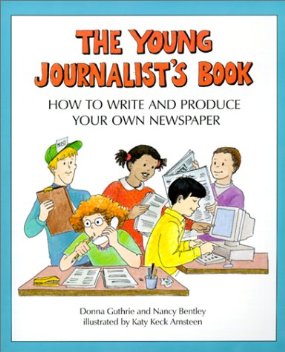
Young Journalist’s Book: How to Write and Produce Your Own Newspaper

CBS anchor Scott Pelley said at a speech at Quinnipiac University that journalists “are getting big stories wrong, over and over again,” as quoted by a commenter on The Idaho State Journal politics blog.
514J0T38H9L._SX285_Young Journalist’s Book: How to Write and Produce Your Own Newspaper, is a great place to help children begin learn the difference between good and bad journalism.
The book is a step-by-step guide that explains what a journalist does, what makes an interesting story, and how newspapers differ from books. Students learn about gathering facts, writing a story, proofreading, designing layout, printing, and distributing their newspaper. There are frequent references to using computers in the process. The authors describe the different types of stories, e.g., news, features, and editorials, with hints on how to write each one and suggestions for topics. This title is similar in format to Guthrie and Bentley’s The Young Author’s Do-It Yourself Book (1994) and The Young Producer’s Video Book (1995, both Millbrook). The full-color cartoons are appealing. Inspirational, practical fare for writers and would-be reporters.-Marion F. Gallivan, Gannon University, Erie, PA
E How talks about the steps to establishing a newspaper at your elementary school. They include:
Brainstorm possible newspaper names and story ideas with your newspaper staff. Articles can be about school-wide news, book reviews, movie reviews and more.

Assign articles to your students. Warn them about the dangers of plagiarism and explain the term to your students. Provide them with a deadline for their articles. Make the deadline reasonable. Since they are elementary school students, they will probably need at least a couple of weeks to complete their articles.

Decide whether you will type the articles into a word processing document or whether you will leave this task up to your staff. Some students know how to type quickly while others haven’t learned keyboarding yet. Be sure you run spell check and proofread the articles.

The Warrior’s Heart: Becoming a Man of Compassion and Courage

images“It’s no small feat to make a difference in somebody’s life, and Greitens has written a book that is a fitting honor to all the people who made a difference in his. By sharing these stories with young readers, he now has a chance to make a difference in a few more.”- The New York Times
Regarding The Warrior’s Heart: Becoming a Man of Compassion and Courage, by Eric Greitens,

 Amazon reviewer By Ken C.  said:
The episodic nature of this book will make it a popular title on the nonfiction shelf. Greitens first talks about his experiences with boxing lessons and humanitarian trips to Bosnia, Rwanda, and Bolivia. Each serves as concrete evidence of the author’s self-discipline and commitment to others. And each is depicted in Greitens’ spare, straightforward writing style.From these early missions, the book moves into Greitens’ long road to becoming a Navy SEAL. The reader is treated to snapshots of many of his comrades and the training regime they suffered to become one of these rare warriors. Though never heavy-handed, Eric Greitens also uses the people he meets as character examples — men that inspired him. Young people should be moved by these examples, as well as by Greitens’ call to action at the end of the book, where he asks that they answer the call to serve by volunteering and making their world (country, town, school, neighborhood, family) a better place.
In this adaptation of his best-selling book, The Heart and the Fist: The education of a humanitarian, the making of a Navy SEAL, Eric speaks directly to teen readers, interweaving memoir and intimate second-person narratives that ask the reader to put themselves in the shoes of himself and others. Readers will share in Eric’s evolution from average kid to globe-traveling humanitarian to warrior, training and serving with the most elite military outfit in the world: the Navy SEALs. Along the way, they’ll be asked to consider the power of choices, of making the decision each and every day to act with courage and compassion so that they grow to be tomorrow’s heroes. Sure to inspire and motivate.Here are some quotes from the book, along with a few of my thoughts:
Pg. 5″Like many American kids, I grew up learning about a world populated by heroes…. I worried that all the corners of the Earth had been explored, all the great battles fought…..My fear was that I’d miss my chance at a meaningful life.”
What little kid doesn’t dream of making a difference? What little boy or girl doesn’t dream of being the hero or heroine.  Whether they dream of being a policeman or firefighter, the momma or the one who breaks the spell, every child dreams of having the power to make a difference.
Pg. 6His parents had told him,  ”perhaps since kindergarten–that I should work hard so I could go to a place called college.  College, they promised, was the ticket…. I imagined the ticket as something golden and shiny, like a ticket for a train that would hurtle me to a place filled with adventures.”
I identify with this because my parents wanted their children to go to college and I dreamed of it.  As a parent, I encourage my children to prepare themselves for college and love to hear their dreams of the things they can do and become.
Pg. 137Eric hits it right on the head when he said of applying for a Rhodes Scholarship,  ”…I had high hopes.  Doing humanitarian work overseas, I realized it isn’t enough to fight for a better world: we also have to live lives worth fighting for.”
How true.
Pg 176-177In Eric’s observation, “Many of the guys grew up in a culture where they’d inherited ideals about manhood from beer commercials and sitcoms.  And whether the men they saw on TV were portrayed as overgrown and selfish boys, or as wimps and goofballs, the men who came to BUD/S knew—even if they didn’t articulate it–that there had to be more to being a man than that.” Eric illustrates the need that many young people feel in our society face.  Too many young men and women need role models like the one Eric describes in his book: “Senior Chief Salazar…..was the eptiome of an excellent trainer.  Every man in our class admired him…..That day on the beach …..he said, “You know what, guys?  I want to tell you something about that it means to be a real frogman.”  ”If you’re a real frogman,” he said, “then every time a woman leaves your side, she’ll feel better about herself.”
Amen!I plan to read this book to my children because it shows a wonderful example of a life well-lived. The work demonstrates the kind of effort that we should each give to living and serving our country and each other.  It also has many excellent observations and insights on the nature of service and about acting with courage and compassion.