Showing posts with label Publishers Weekly. Show all posts

Wednesday, September 25, 2013

Children’s Books that Build Character

GreenEggsHam1A column called A bicycle for a little girl had me thinking about its connections to children’s literature, reading and learning.
“Aren’t you the little girl who is always in here looking at bikes?” Emily nodded. “Is this going to be your bike?” Again she nodded. He smiled and turned to me, “You know, the shop ain’t that busy right now. You just pay for half of them, I’ll donate the other half, and I’ll fix it up for free.”
I nodded my agreement, and Emily ran to him and gave him a big hug. The old man smiled. “I’d say a hug is darned good pay.”

I paid my part, and a few days later we took Emily to the store to pick up her bike. Her happiness when she rode it was pay enough for all of us. As we left the store, Emily turned to me. “Is Mr. Johnson one of the angels you told me about that God has here that helps people?”
I nodded. “I’m sure he is, Emily. There are lots of them all around us.”
Emily rode her bike everywhere after that, and everyone loved her and watched out for her. One Saturday, as she ate dinner with us, she was unusually quiet. “What’s the matter, Emily?” I asked.
“You go to church every Sunday and learn about God, don’t you?” she asked. I nodded, so she continued. “Do you think God would let me come to church, too?”
“Of course He would,” I said. “Why do you ask?”
“Because I want to become an angel and help people, too,” she replied
“You don’t have to go to church to be an angel or to help people,” I said.
What kinds of children’s books with lessons are most enjoyable for young readers?

Here are three of my favorites:

Green Eggs & Ham by Dr. Seuss : This book is all about trying new things, when those new things seem strange or unappealing. This classic Dr. Seuss title rhythmic and lyrical and hilarious in a way that both children and adults can appreciate. Dr. Seuss argues his point by reducing the fear of trying new things to absurdity, showing what zany trials the creature in the hat will go through to avoid tasting the green eggs and ham. Ultimately, Seuss shows, in colorful terms, that there is nothing to fear but fear itself. Once we overcome our fears–of foods, people, activities–we open ourselves to new and enjoyable experiences which can bring a splash of zest to the monotony of daily life. I always enjoy getting to the very end when the main character tastes the eggs and ham.

The Berenstain Bears and the Messy Room by Stan & Jan Berenstain : ”The room shared by Brother and Sister is a mess because the cubs argue over who should neaten up instead of working together. Sure to make toddlers smile while they absorb an implied lesson,” according to Publishers Weekly.  The Berenstain Bears’ books offer many lessons. This book  starts with a problem (a messy room) and ends with a happy solution that the whole family works on together.

It’s Time to Start Using Your Words by Lawrence Shapiro : Young children accustomed to expressing themselves with tantrums, gestures, or simple silence need to learn that using their words is the best way to make their thoughts and feelings heard. This book helps kids learn to say ‘please’ and ‘thank you’ and express themselves in productive ways. The book is written by child psychologist Lawrence Shapiro and includes language development information and advice for parents. Reading this book at storytime is a great way to encourage your child to communicate with words and leave crying and shyness behind. The book follows several children as they do normal daily activities and encourages them to use words to express their feelings or make requests, as opposed to just pointing or crying. For years, before reading this book, I found myself saying “Please use your words…” to my young children throughout the day. It’s nice to have found a book that reinforces that concept.

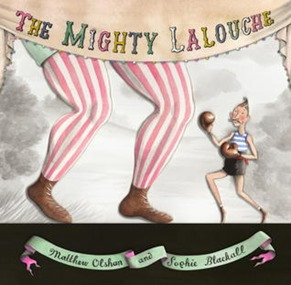
THE MIGHTY LALOUCHE: A charming tale by Matthew Olshan that holds a few surprises between its pages

mighty-laloucheOne hundred and a few-odd years ago, in Paris, France, there lived a humble postman named Lalouche. He was small, but his hands were nimble, his legs were fast, and his arms were strong. In THE MIGHTY LALOUCHE, the extraordinary happens when Monsieur Lalouche takes to the ring and proves himself a boxer extraordinaire. “C’est impossible!”  you say? This charming tale by Matthew Olshan, illustrated by New York Times Best Illustrated Award winner Sophie Blackall, holds a few surprises between its pages.
__
 
Lalouche is an endearingly oddball hero, and Blackall takes her always-exquisite
ink-and-watercolor artwork to another level. . . . C’est formidable!”
—Publishers Weekly, Starred
 
When his job is replaced by an electric car, the postman Lalouche turns to boxing to support himself and his pet finch, Genevieve. But—“You? A boxer?” the fighters ask. “I could sneeze and knock you down!” Still, Lalouche refuses to give up. Weathering such threats as “I’ll zap him,” “I’ll tie him in a pretty bow,” and, most alarmingly, “I’ll squeeze him till he pops!” Lalouche nimbly thwarts each of his frightening foes in the ring, proving that size is no indicator of strength or will.
 
This marvelous story, full of humor and heart, salutes the unlikely champions who remind young readers that creativity and wit trump brute force. As the plot unfolds in Paris, France, in the early 1900s, readers are treated to historical details, heightened by Blackall’s clever, kid-friendly art. In keeping with the historical nature of the story, Blackall uses the nearly forgotten Japanese paper diorama art style called tatebanko for this book to stunning effect.
__
“The illustrations are outstanding–Blackall has outdone herself. . . .
The text and pictures work expertly together.”
—School Library Journal, Starred
 
was written specifically for Sophie Blackall after Matthew Olshan discovered that she collected old pictures of boxers, especially “extremely skinny ones with big billowing boxing trunks.”
 
MATTHEW OLSHAN is the author of Finn: A Novel, a modern telling of Mark Twain’s The Adventures of Huckleberry Finn, with girls as protagonists rather than boys. His latest novel, The Flown Sky, is a fantasy in the tradition of C. S. Lewis’s Narnia Chronicles. Olshan lives in Baltimore, but also has a little farm in south central Pennsylvania, called Pencil Creek.
 
SOPHIE BLACKALL received the New York Times Best Illustrated Award for her book Big Red Lollipop, and won the Ezra Jack Keats Award for New Talent. She is the illustrator of Meet Wild Boars, a Bulletin Blue Ribbon Book; Jumpy Jack & Googily; What’s So Bad About Being an Only Child?; Summer Is Summer; Edwin Speaks Up; and others. A native of Australia, she lives in Brooklyn, New York.

Wednesday, August 21, 2013

Absolutely Normal Chaos (and teaching tips to use Sharon Creech Novels)

indexMary Lou Finney is less than excited about her assignment to keep a journal over the summer. She also has to read The Odyssey, which she often relates to her own story. Then her cousin Carl Ray comes to stay with her family, under the pretense of looking for a job, which he eventually finds at Mr. Furtz’s hardware store. Over the course of the summer, she learns about the difficulties that Carl Ray has faced throughout his life and on a trip to visit his parents, she finds out why he never makes his bed. She also hangs out with her best friend Beth Ann and becomes Alex Cheevey’s girlfriend. As Mary Lou’s story unfolds, she examines both her struggles with her family and her own sense of self.

Sharon Creech stated that the inspiration for this story was an occasion when, “I’d been living overseas (England and Switzerland) for about ten years, and I was sadly missing my family back in the States. I thought I’d write a story about normal family chaos and that’s how this began, with me trying to remember what it was like growing up in my family. Writing the story was a way for me to feel as if my family were with me, right there in our little cottage in England.”

Absolutely Normal Chaos is a young-adult novel by Sharon Creech, published in the U.K. by Macmillan Children’s Books in 1990. It was the American author’s first book for children, completed at the midpoint of nearly two decades living in England and Switzerland. Although set in her hometown Euclid, Ohio, it was not published in her native country until 1995 (HarperCollins), after she won the annual Newbery Medal recognizing Walk Two Moons as the preceding year’s best American children’s book.

Absolutely Normal Chaos is a 13-year-old girl’s “complete and unabridged journal for English class” and can be classed as a bildungsroman, a novel of formation, novel of education, or coming-of-age story. In this literary genre the focus is on the psychological and moral growth of the protagonist from youth to adulthood (coming of age). And in which, therefore, character change is extremely important.

In what by now must be a subgenre in YA fiction — the novel cast as a journal written for an English assignment — Newbery Medalist Creech (Walk Two Moons) spins an affable if formulaic tale about one pivotal summer, according to Publishers Weekly. 
Narrator Mary Lou, 13, the second of the five Finney children, is quite put out when she has to play maid for her uncommunicative cousin Carl Ray, 17, who comes to stay while he looks for a job. He gets one, to Mary Lou’s surprise, at the hardware store owned by their new neighbor Mr. Furtz, who shortly afterward dies of a heart attack. Not only does Carl Ray remain in his new job, but an anonymous benefactor leaves him money-just like in Great Expectations, as Mary Lou points out. There the resemblance to Dickens ends: the astute reader will early on figure out the mystery behind Carl Ray’s inheritance. Mary Lou is also slow to pick up clues about why her cute classmate Alex is always hanging around. Despite the occasionally creaky plot, Mary Lou’s bouncy entries are still a lot of fun. Readers will enjoy her wry commentary on The Odyssey (on the school reading list), and girls especially will identify with Mary Lou’s disgust at the giddy behavior of boy-crazy best friend Beth Ann and her own giggly rhapsodies on her first romance (“I am sooooo happeeeeee I can hardly stand it!”).
Creech’s newest story is told as a summer journal begrudgingly started as an English assignment, reads a review from School Library Journal.
Mary Lou, 13, wonders if kisses with boys really taste like chicken; if her best friend will ever shut up about her new boyfriend; and how her visiting cousin, Carl Ray, can be such a silent clod, especially when someone has anonymously given him $5000. Later, when he is in a coma following a car accident, she rereads her journal and wonders how she could have been so unseeing. Mary Lou is a typical teen whose acquaintance with the sadder parts of life is cushioned by a warm and energetic family. Her entertaining musings on Homer, Shakespeare, and Robert Frost are drawn in nifty parallels to what is happening in her own life. When forbidden by her mother to say “God,” “stupid,” and “stuff,” she makes a trek to the thesaurus to create some innovative interjections. Creech’s dialogue is right on target. Her characterization is nicely done also. By comparison, this book is differently voiced than Walk Two Moons (HarperCollins, 1994), lacks that book’s masterful imagery, and is more superficial in theme; but appropriately so. Creech has remained true to Mary Lou, who is a different narrator, and one who will win many fans of her own. Those in search of a light, humorous read will find it; those in search of something a little deeper will also be rewarded.
TEACHING TIPS TO USE Absolutely Normal Chaos:
Literature Circles are small discussion groups comprised of 4 to 5 students, each of whom has a specific role and function. Literature Circles can be used in one of two ways: (1) each group reads a different book or (2) the entire class reads the same book. This student centered instructional technique enables each student to participate regardless of his or her reading level.
Assessment in Literature Circles can be both formal and informal and determined with student input. The students lead discussions in their small groups and the teacher acts as mediator and facilitator.

This teacher’s guide illustrates how to set up Literature Circles and use them to teach the novels of Sharon Creech.