Showing posts with label literature. Show all posts

Monday, October 7, 2013

Strategies for the ACT English Test

 It’s that time of year again. College applications are flowing out of high school students and parents are getting nervous. testing is a huge part of the formula, so here are some suggestions and resources  to help keep nerves calm:

Barron’s ACT English, Reading, and Writing Workbook by Linda Carnevale gives college-bound students extensive practice and review that will help them excel on all three verbal sections and all four reading genres of the ACT. An introductory overview explains the formats for the English Test, the Reading Test, and the Writing Test. A full-length self-assessment test follows with an answer key and explanations to help students assess their strengths and weaknesses. Succeeding chapters review the subject matter of all three tests and present drills, strategies, practice questions, study advice, and test-taking tips. Students review English grammar, punctuation, and style. They sharpen their reading comprehension with practice passages in the Humanities, Natural Science, Prose Fiction, and Social Science. Finally, they hone their essay-writing skills, guided by the author’s instruction in organizing their ideas, writing a rough draft, and editing the finished essay. A final chapter presents a full-length practice test with answers and explanations.

The Grokit website says:

1. Think simple.  As far as the ACT is concerned, the best writing uses the fewest possible number of words to convey an idea.  This doesn’t always mean the shortest answer is the best answer–sometimes more words are needed in order for a phrase or sentence to be grammatically correct.  But in general avoid answer choices that seem wordy.  The best answers are concise and clear.

2. Take the whole sentence into account.  It’s easy to read just the underlined portion the question asks about, or maybe just the clause that the underlined portion is a part of.  However, many times the other clause or clauses in the sentence can affect your answer.  For example, if the other clause is an independent clause, you will need to make sure that the underlined portion does not create a comma splice with another independent clause.  Read the whole sentence to yourself and you will be less likely to overlook an error.


ACT English Scoring

Just like the other sections, the ACT English section can earn you between 1 and 36 points. This score will be averaged with the scores from the other multiple-choice sections (Math, Science Reasoning and Reading) to get you your Composite ACT score. You’ll also get a subscore for both the Usage/Mechanics and Rhetorical skills subcategories between 1 and 18. These subscores having nothing whatsoever to do with your overall score, and most colleges and universities will not care what your subscores are. Strange, but true. The average ACT English score is about a 21, but you’ll have to do much better than that if you’d like to hit up a top university for admissions acceptance – more like between a 30 and 34.  Source: About.com

 10 Tips for the ACT English Test

  1. Skim an English passage before starting work on the questions
  2. On questions that ask you to judge a passage, lean toward selecting a choice that favors it
  3. Choose answers that match the level of formality of the entire passage
  4. The best way to write something is the shortest correct way of writing it
  5. If you speak a “nonstandard” dialect, be extra careful with questions that focus on idioms
  6. Watch for subject-verb and noun-pronoun agreement
  7. Make sure parenthetical phrases begin and end with the same punctuation mark
  8. Look out for sentence fragments and run-on sentences
  9. Make sure that nouns and pronouns are modified by adjectives, and that verbs and adjectives are modified by adverbs
  10. Learn the difference between it’s and its
Source: Kaplan Test Prep

Wednesday, September 25, 2013

Children’s Books that Build Character

GreenEggsHam1A column called A bicycle for a little girl had me thinking about its connections to children’s literature, reading and learning.
“Aren’t you the little girl who is always in here looking at bikes?” Emily nodded. “Is this going to be your bike?” Again she nodded. He smiled and turned to me, “You know, the shop ain’t that busy right now. You just pay for half of them, I’ll donate the other half, and I’ll fix it up for free.”
I nodded my agreement, and Emily ran to him and gave him a big hug. The old man smiled. “I’d say a hug is darned good pay.”

I paid my part, and a few days later we took Emily to the store to pick up her bike. Her happiness when she rode it was pay enough for all of us. As we left the store, Emily turned to me. “Is Mr. Johnson one of the angels you told me about that God has here that helps people?”
I nodded. “I’m sure he is, Emily. There are lots of them all around us.”
Emily rode her bike everywhere after that, and everyone loved her and watched out for her. One Saturday, as she ate dinner with us, she was unusually quiet. “What’s the matter, Emily?” I asked.
“You go to church every Sunday and learn about God, don’t you?” she asked. I nodded, so she continued. “Do you think God would let me come to church, too?”
“Of course He would,” I said. “Why do you ask?”
“Because I want to become an angel and help people, too,” she replied
“You don’t have to go to church to be an angel or to help people,” I said.
What kinds of children’s books with lessons are most enjoyable for young readers?

Here are three of my favorites:

Green Eggs & Ham by Dr. Seuss : This book is all about trying new things, when those new things seem strange or unappealing. This classic Dr. Seuss title rhythmic and lyrical and hilarious in a way that both children and adults can appreciate. Dr. Seuss argues his point by reducing the fear of trying new things to absurdity, showing what zany trials the creature in the hat will go through to avoid tasting the green eggs and ham. Ultimately, Seuss shows, in colorful terms, that there is nothing to fear but fear itself. Once we overcome our fears–of foods, people, activities–we open ourselves to new and enjoyable experiences which can bring a splash of zest to the monotony of daily life. I always enjoy getting to the very end when the main character tastes the eggs and ham.

The Berenstain Bears and the Messy Room by Stan & Jan Berenstain : ”The room shared by Brother and Sister is a mess because the cubs argue over who should neaten up instead of working together. Sure to make toddlers smile while they absorb an implied lesson,” according to Publishers Weekly.  The Berenstain Bears’ books offer many lessons. This book  starts with a problem (a messy room) and ends with a happy solution that the whole family works on together.

It’s Time to Start Using Your Words by Lawrence Shapiro : Young children accustomed to expressing themselves with tantrums, gestures, or simple silence need to learn that using their words is the best way to make their thoughts and feelings heard. This book helps kids learn to say ‘please’ and ‘thank you’ and express themselves in productive ways. The book is written by child psychologist Lawrence Shapiro and includes language development information and advice for parents. Reading this book at storytime is a great way to encourage your child to communicate with words and leave crying and shyness behind. The book follows several children as they do normal daily activities and encourages them to use words to express their feelings or make requests, as opposed to just pointing or crying. For years, before reading this book, I found myself saying “Please use your words…” to my young children throughout the day. It’s nice to have found a book that reinforces that concept.

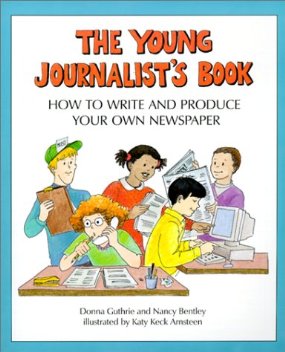
Young Journalist’s Book: How to Write and Produce Your Own Newspaper

CBS anchor Scott Pelley said at a speech at Quinnipiac University that journalists “are getting big stories wrong, over and over again,” as quoted by a commenter on The Idaho State Journal politics blog.
514J0T38H9L._SX285_Young Journalist’s Book: How to Write and Produce Your Own Newspaper, is a great place to help children begin learn the difference between good and bad journalism.
The book is a step-by-step guide that explains what a journalist does, what makes an interesting story, and how newspapers differ from books. Students learn about gathering facts, writing a story, proofreading, designing layout, printing, and distributing their newspaper. There are frequent references to using computers in the process. The authors describe the different types of stories, e.g., news, features, and editorials, with hints on how to write each one and suggestions for topics. This title is similar in format to Guthrie and Bentley’s The Young Author’s Do-It Yourself Book (1994) and The Young Producer’s Video Book (1995, both Millbrook). The full-color cartoons are appealing. Inspirational, practical fare for writers and would-be reporters.-Marion F. Gallivan, Gannon University, Erie, PA
E How talks about the steps to establishing a newspaper at your elementary school. They include:
Brainstorm possible newspaper names and story ideas with your newspaper staff. Articles can be about school-wide news, book reviews, movie reviews and more.

Assign articles to your students. Warn them about the dangers of plagiarism and explain the term to your students. Provide them with a deadline for their articles. Make the deadline reasonable. Since they are elementary school students, they will probably need at least a couple of weeks to complete their articles.

Decide whether you will type the articles into a word processing document or whether you will leave this task up to your staff. Some students know how to type quickly while others haven’t learned keyboarding yet. Be sure you run spell check and proofread the articles.

BEAN DOG & NUGGET: Charise Mericle Harper Cooks Up Another Great Book Idea

Bean-Dog-235x300This is an excerpt from an excellent blog entry by Charise Mericle Harper.
The other day I was at my son’s book fair, talking with his teacher. A few of my books were included in the event, and she picked one up and flipped through it. All of a sudden she asked, “Where do you get your ideas?” I’m pretty good at answering this question at school talks, but on the spot, I was speechless. I ended up smiling uncomfortably, shrugging my shoulders and saying, “I don’t know,” and then I quickly changed the subject.

On stage and in front of a group, I’m fine with the spotlight, but in a social situation, the last thing I’m comfortable talking about is me. Later that day, I started feeling guilty about how I’d responded. I should have made more of an effort to answer her, because her question was a good one. In fact, it was the exact same question I always want to ask other authors and illustrators. It’s why I’m always excited to meet them. I want to know: How do you do that thing that you do? Where do you get your ideas? And how do you get those ideas to swirl together perfectly so you can use them?
Read the full text of:  BEAN DOG & NUGGET: Charise Mericle Harper Cooks Up Another Great Book Idea
Using simple text and cartoon-style illustrations, Charise Mericle Harper introduces young readers to a new graphic novel series, Bean Dog and Nugget.These two engaging characters capture young kids’ actions, reactions, conversations, imagination, and humor with spot-on accuracy. Kids will want to follow Bean Dog and Nugget and their adventures in each and every book in the series.
In The Ball, Bean Dog and Nugget lose Bean Dog’s shiny new ball in a bush. They dream up elaborate and silly ways to get it back while they argue about who is actually going to go and get it. Enter Superdog and Ninja Nugget for a hilarious ending that kids will love and relate to.

CHARISE MERICLE HARPER has written and illustrated numerous children’s books, including Just Grace; Wedgieman: A Hero Is Born; Wedgieman to the Rescue; The Power of Cute; Gigi in the Big City; Milo’s Special Words; Good Night, Leo; Pink Me Up; When Randolph Turned Rotten; Fashion Kitty; and Fashion Kitty Versus the Fashion Queen. She lives in Mamaroneck, New York, with her husband and their two children. Charise loves creating art and stories, petting her cat, drinking coffee, and eating pie.

350 Fabulous Writing Prompts: Thought-Provoking Springboards For Creative, Expository, and Journal Writing

index350 Fabulous Writing Prompts: Thought-Provoking Springboards For Creative, Expository, and Journal Writing Paperback by Jacqueline Sweeney highlights creative, engaging, thought-provoking prompts for every day of the school year! More than 300 ways to motivate even your most reluctant writers. Topics include feelings, ethics, “imagineering,” quotations, humor, problem-solving, school situations, and so much more. For use with Grades 4-8.

Creative writing is any writing that goes outside the bounds of normal professional, journalistic, academic, or technical forms of literature, typically identified by an emphasis on narrative craft, character development, and the use of literary tropes. Due to the looseness of the definition, it is possible for writing such as feature stories to be considered creative writing, even though they fall under journalism, because the content of features is specifically focused on narrative and character development. Both fictional and non-fictional works fall into this category, including such forms as novels, biographies, short stories, and poems. In the academic setting, creative writing is typically separated into fiction and poetry classes, with a focus on writing in an original style, as opposed to imitating pre-existing genres such as crime or horror. Writing for the screen and stage—screenwriting and playwriting—are taught separately, but fit under the creative writing category as well.

Also consider Coming to Know by Nancy Atwell. This  book is for teachers who are ready to put writing to work across the curriculum. It is written by teachers of grades 3 through 6 who, dissatisfied with encyclopedia-based approaches to content-area writing, asked their students to write as scientists, historians, mathematicians, and literary critics do – to use writing-as-process to discover meaning.
One of the subjects of this volume is report writing and ways to help children produce content-area writing that is as personal and meaningful as their stories of their own experiences. Students learn how to take notes in their own words, conduct interviews, record observations, design their first simple research project, select appropriate genres for their research, and apply the techniques of writing workshop in science, social studies, and reading classes.

In addition, Coming to Know explores the uses of academic journals, or learning logs. Children speculate, brainstorm, role play, correspond, predict, and ask questions about math, reading, science, and social studies – and demonstrate the power of informal writing to generate thinking. Coming to Know is also about the connections between reading and writing, the effects of using writing to learn on curriculum and planning, and the role of children’s literature in teaching science, social studies and math.

Mastering Basic Grammar and Usage for the ACT

51IMsRplD4L._SY300_As you’ve probably already gathered, the English Test will never explicitly ask you to name a grammatical error, reads SparkNotes.  “But in order to identify and fix errors, you should know what they are. While you’ll often be able to rely on your ear to detect errors, many of the questions will ask you to fix phrases that are fine for spoken English but not for formal written English.”
***
The ACT test description states:
Spelling, vocabulary, and rote recall of rules of grammar aren’t tested. See sample questions or read tips and strategies.The test consists of five prose passages, each one accompanied by multiple-choice test questions. Different passage types are included to provide variety.
Some questions refer to underlined portions of the passage and offer several alternatives to the underlined portion. You must decide which choice is most appropriate in the context of the passage.
Some questions ask about an underlined portion, a section of the passage, or the passage as a whole. You must decide which choice best answers the question posed.
Many questions include “NO CHANGE” to the underlined portion or the passage as one of the choices.
The questions are numbered consecutively. Each question number corresponds to an underlined portion in the passage or to a box located in the passage.
Several  grammar issues, appear on the ACT English Test, including:
  1. Subject-Verb Agreement
  2. Pronoun-Antecedent Agreement
  3. Pronoun Cases
  4. Verb Tenses
  5. Adverbs and Adjectives
  6. Idioms
  7. Comparative and Superlative Modifiers
RECOMMENDED READING: Grammar Workbook for the SAT, ACT, and More, by George Ehrenhaft Ed.D.
A solid command of English grammar is a prerequisite for success when students take the SAT, ACT, and other college entrance tests. This workbook presents a detailed grammar review with dozens of practice quizzes and exercises to sharpen students’ skills. It begins with an explanation of grammatical terms and their functions. It then describes the 24 most common mistakes made by students and shows how to avoid them. Prominent among them are lack of agreement between subject and verb, misuse of pronouns, faulty parallel structure, and faulty punctuation. A final chapter focuses on advice and instruction for writing error-free SAT and ACT essays. This workbook is filled with sample questions exactly like those found on both the SAT and ACT, and comes with fully explained answers.
FURTHER RESOURCES:
Pronoun Case Quiz (Guide to Cases of Nouns and Pronouns with two quizzes) http://grammar.ccc.commnet.edu/grammar/cases.htm
Verb Tense Quiz: http://grammar.ccc.commnet.edu/grammar/quizzes/tenses/tenses_frame.html

Wednesday, August 21, 2013

Creative Writing Lesson Plan

“Perhaps then, someday in the future, you will gradually, without even noticing it, live your way into the answer. ” —Rainer Maria Riike, Letters To A Young Poet.

Welcome to Summer 2013 Creative Writing!

NOTE: YOU WILL SEE DOZENS OF ENTRIES ON THIS SITE ABOUT LITERATURE FOR YOUNG PEOPLE. ONLY THOSE WITH THE CATEGORY “Creative Writing Summer 2013″ ARE REQUIRED FOR THIS CLASS. THE REST ARE RECOMMENDED READING.

This video shows, as one commenter said, how “poetry (like all art) is subjective… I may like Disturbed, you may like Lady Ga Ga, he may like Jack Johnson, she may like Bethoven. None of it is wrong. It’s art. An expression that can not be measured except by how it moves you. (or doesn’t move you).”
_____
Be sure to review the syllabus for this class. It can be found by CLICKING HERE or by using this link: http://youngpeoplespavilion.com/summer-2013-creative-writing-syllabus/
A few important reminders:

* Check this website regularly for class updates and material. If you have a question such as: “I missed class, can you tell me what we did and what is due?” … this website is the spot to find your answer.
Recommended Reading:  Letters to a Young Poet, by Rainer Maria Rilke
Recommended Reading: Letters to a Young Poet, by
Rainer Maria Rilke

* Click on the “Creative Writing Summer 2013″ category below this post, and all class lesson plans (posted as of that date) will come up.

* This site will also be used for updates and announcements.
* Each class will include a 10 point “What I have learned in this class” assessment.
* All writing that will be graded must be submitted to me as a Microsoft Word Document. We will have time in class for you to transfer work from your flash drives.
* We have chosen certain texts that exemplify the craft of creative writing. If at any time a student/parent objects to any material used, I would be more than happy to accommodate by working together with all parties to choose an alternate text.
_____
In class today:
Class overview and syllabus review
Introductions
What is Poetry?
VIDEO: “O Captain! My Captain!” by Walt Whitman (See: Summer 2013 Creative Writing Videos)

Assessments:
1) What I have learned in this class  (10 points) Due by end of class period 6/10/13.
2) There will be a quiz on Literary and Poetry Terminology  (25 points). It will be short answer and multiple choice. Given in class Wednesday, 6/12/2013.
3)  FIRST WRITING ASSIGNMENT: Write your own poem: (50 points). Due Friday, 6/14, 2013. (See: Summer 2013 Creative Writing Assignments)
_____
What is poetry?
SOURCE: http://www.poetry.org/whatis.htm
Poetry (ancient Greek: ποιεω (poieo) = I create) is an art form in which human language is used for its aesthetic qualities in addition to, or instead of, its notional and semantic content. It consists largely of oral or literary works in which language is used in a manner that is felt by its user and audience to differ from ordinary prose.

It may use condensed or compressed form to convey emotion or ideas to the reader’s or listener’s mind or ear; it may also use devices such as assonance and repetition to achieve musical or incantatory effects. Poems frequently rely for their effect on imagery, word association, and the musical qualities of the language used. The interactive layering of all these effects to generate meaning is what marks poetry.
Because of its nature of emphasising linguistic form rather than using language purely for its content, poetry is notoriously difficult to translate from one language into another: a possible exception to this might be the Hebrew Psalms, where the beauty is found more in the balance of ideas than in specific vocabulary. In most poetry, it is the connotations and the “baggage” that words carry (the weight of words) that are most important. These shades and nuances of meaning can be difficult to interpret and can cause different readers to “hear” a particular piece of poetry differently. While there are reasonable interpretations, there can never be a definitive interpretation.

Click in this link http://www.poetry.org/whatis.htm to read more, including 

Nature of poetry

Sound in poetry

Poetry and form

Poetry and rhetoric

History of poetry

VIDEO: “Literary Devices” (See: Summer 2013 Creative Writing Videos)
TERMS:
1) figurative language
2) simile
3) metaphor
4) personification
5) hyperbole
6) alliteration
7) onomatopoeia
8) assonance
9) consonance
DEFINITIONS
1) communicates ideas beyond the ordinary, literal meaning of words
2) compares unrelated nouns, usually using the words “like” or “as”
3) an implied comparison that does not use the words like or as
4) giving human characteristics to inanimate objects, ideas, or animals
5) an exaggeration for the sake of emphasis, not to be taken literally
6) repetition of the initial letter or sound in two or more words in a line of verse
7) a word that represents or imitates natural sounds
8) the similarity or repetition of a vowel sound in two or more words
9) the repetition of final consonant sounds within a line of verse
HERE ARE A FEW EXAMPLES:
1)
  • Alright, the sky misses the sun at night.
  • Hear the mellow wedding bells. – Edgar Allen Poe
  • Out of reach, I pull out with a screech.
  • I move fast like a cheetah on the Serengeti.
  • Her head was spinning from all the new information.
  • The toast jumped out of the toaster.
  • I’m so hungry I could eat a horse.
  • The Sea lashed out in anger at the ships, unwilling to tolerate another battle.
  • The Redcoats are coming!
  • I’ve told you a million times to clean your room!
2)
 A Red, Red Rose
O My Luve’s like a red, red rose,
That’s newly sprung in June;
O My Luve’s like the melodie
That’s sweetly played in tune.
As fair art thou, my bonnie lass,
So deep in luve am I;
And I will luve thee still, my dear,
Till a’ the seas gang dry, my dear
While the sands o’ life shall run.
And fare thee weel, my only luve,
And fare thee weel, awhile!
And I will come again, my luve
Tho’ it ware ten thousand mile!

Robert Burns
1759-1796

Here are examples of  similie poems by Denise Rodgers:
Link: http://examples.yourdictionary.com/examples-of-simile-poems.html
3) One of the most prominent examples of a metaphor in English literature is the All the world’s a stage monologue from As You Like It:
All the world’s a stage,
And all the men and women merely players;
They have their exits and their entrances; — William Shakespeare, As You Like It, 2/7[1]
This quote is a metaphor because the world is not literally a stage. By figuratively asserting that the world is a stage, Shakespeare uses the points of comparison between the world and a stage to convey an understanding about the mechanics of the world and the lives of the people within it.
_____
ThinkWave.com will be used for grading.

Saturday, August 17, 2013

Creative Writing Lesson Plan

Nice job yesterday. I really enjoyed meeting all of you and was impressed by the way you exhibited seriousness about this class and about your writing. Keep up that attitude and we will have a very fruitful summer session.

Here are some materials for our Tuesday meeting:
Recommended Reading:  Six Centuries Of English Poetry: Tennyson To Chaucer (1892) by James Baldwin
Recommended Reading: Six Centuries Of English Poetry: Tennyson To Chaucer (1892) by James Baldwin
“Ain’t I a Woman?” is the name given to a speech, delivered extemporaneously, by Sojourner Truth, (1797–1883), born into slavery in New York State. Some time after gaining her freedom in 1827, she became a well known anti-slavery speaker. Her speech was delivered at the Women’s Convention in Akron, Ohio, on May 29, 1851, and was not originally known by any title. It was briefly reported in two contemporary newspapers, and a transcript of the speech was published in the Anti-Slavery Bugle on June 21, 1853.
Here is the text of the speech. I use the speech in this class because it has great examples of several of the literary devices we discuss. (See: Summer 2013 Creative Writing Videos)
The speech received wider publicity in 1863 during the American Civil War when Frances Dana Barker Gage published a different version, one which became known as Ain’t I a Woman? because of its oft-repeated question. This later version was the one recorded in most history books.
_____
VIDEO:  Similes and Metaphors in Pop Music (See: Summer 2013 Creative Writing Videos).
We will also discuss the video: Pat Pattison on The Inspiration Behind Creative Writing: Poetry  (See: Summer 2013 Creative Writing Videos). In it he refers to greatly inspired by Leonard Bernstein. Bernstein was an American composer, conductor, author, music lecturer, and pianist. He was among the first conductors born and educated in the United States of America to receive worldwide acclaim. According to The New York Times, he was “one of the most prodigiously talented and successful musicians in American history.” He is quite possibly the conductor whose name is best known to the public in general, especially the American public.

Pattison refers to Bernstein’s Harvard lectures:
ON a November evening in 1973, in the final moments of the sixth and last of his Norton Lectures at Harvard University, Leonard Bernstein offered what he described as a personal credo: a summation of his beliefs about music as he looked into the final quarter of the 20th century.
He was, by then, nearing the end of his tenure as the university’s Charles Eliot Norton Professor of Poetry, an interdisciplinary chair despite its title. And in the weeks leading up to that evening, he had delivered nearly 13 hours of lectures, liberally illustrated with musical examples at the piano and on projected slides as well as in a handful of luminous videotaped performances with the Boston Symphony conducted by Bernstein.
He had drawn analogies between music and linguistics, and he had traced the increasing complexity of harmonic language from Bach and Mozart to Schoenberg and Stravinsky. Now, tying up the strands of his argument, he offered what in retrospect seems a prescient prediction.
Read the full New York Times article here.
Literary and Poetry Terminology
Here is a review of our terms and definitions from yesterday (Monday, 6/10/13):
TERMS:
1) figurative language
2) simile
3) metaphor
4) personification
5) hyperbole
6) alliteration
7) onomatopoeia
8) assonance
9) consonance

DEFINITIONS
1) communicates ideas beyond the ordinary, literal meaning of words
2) compares unrelated nouns, usually using the words “like” or “as”
3) an implied comparison that does not use the words like or as
4) giving human characteristics to inanimate objects, ideas, or animals
5) an exaggeration for the sake of emphasis, not to be taken literally
6) repetition of the initial letter or sound in two or more words in a line of verse
7) a word that represents or imitates natural sounds
8) the similarity or repetition of a vowel sound in two or more words
9) the repetition of final consonant sounds within a line of verse

Also, yesterday I opened class by reading the poem Annabel Lee  by Edgar Allan Poe
Link: http://poestories.com/read/annabellee
_____
Meet Kioni “Popcorn” Marshall, (See: Summer 2013 Creative Writing Videos) an extraordinary 12-year-old poet from the Bronx. Despite her age, Kioni has earned the respect and admiration of the NYC poetry community by developing her own unique voice and bravely exploring mature themes like alienation, abandonment, loneliness, and abuse. Follow Kioni’s emotional journey as she prepares for her first featured performance at New York’s famed Nuyorican Poets Cafe.

Dead Poets Society: Creative Writing Lesson Plan

Yesterday we watched Dead Poets Society and wrote and shared abut what the movie meant to each of us, as well as what we learned about poetry from the film.

Recommended Reading: Dead Poets Society [Mass Market Paperback] N. H. Kleinbaum (Author)

Recommended Reading: Dead Poets Society [Mass Market Paperback N. H. Kleinbaum (Author)
Todd Anderson and his friends at Welton Academy can hardly believe how different life is since their new English professor, the flamboyant John Keating, has challenged them to “make your lives extraordinary!  ” Inspired by Keating, the boys resurrect the Dead Poets Society–a secret club where, free from the constraints and expectations of school and parents, they let their passions run wild.  As Keating turns the boys on to the great words of Byron, Shelley, and Keats, they discover not only the beauty of language, but the importance of making each moment count.
But the Dead Poets pledges soon realize that their newfound freedom can have tragic consequences.  Can the club and the individuality it inspires survive the pressure from authorities determined to destroy their dreams?
While we are discussing cinema and the connections that all art forms have to each other and to creative writing, here are some interesting links: 10 Great Movies Based on Poems
Link: http://flavorwire.com/387561/10-great-movies-based-on-poems
We’re all pretty comfortable with the idea of movies based on books — fiction, nonfiction, and even self-help books — but what about books of poetry? Last week, Open Culture posted a fascinating film based on the poetry of Sylvia Plath. While it might seem surprising to see a film based on a poem, it’s actually probably a lot more common than you think. To prove it, find ten great films based on poetry after the jump. Don’t see your favorite? Add it to the list in the comments.

And here are Films for Poetry Month:
Link: http://www.rhombusmag.com/2010/04/12/film-movies-for-poetry-month/
A lot of the time, real poetry gets a bad rap. It’s foisted on teenagers in high school English classes, most of whom have no idea why they’re reading it, and who are excited to put it permanently behind them. Or at least, that was my experience.
 Poetry, however, doesn’t all suck. And in fact, this month is officially National Poetry Month, which celebrates the best works by both living and dead poets. (Yes, there still are people writing serious poetry — and it isn’t all penned by “anonymous” or ideally suited to church.) So if you haven’t read a poem since looking at “The Red Wheelbarrow” when you were 15, now is a perfect time to give it a second chance. Poetry, after all, may be a dying art, but knowing a thing or two about it can still make you look like a badass.
 In celebration of National Poetry Month, what follows is a list of poetry-related movies. Maybe you’ve seen them, maybe you haven’t, but chances are you haven’t read everything by all the poets they depict. So this April, watch a movie, read a poem, and impress a girl or boy.
One of my favorites is A Knight’s Tale (2001) —
With Heath Ledger’s death in 2008, this film will always be remembered as one of the star’s funnest and most adored works. Yet, it’s also important to remember that the film is possibly the most entertaining depiction of Chaucer in all of cinema. In the film, Chaucer is basically Ledger’s PR man, giving rousing speeches before violent tournaments. In real life, Chaucer is perhaps the first person ever to write poetry in actual English. He wrote The Canterbury Tales about a bunch of pilgrims, which along with his other works helped turn English into a formal, normalized language. Of course, none of that is shown in A Knight’s Tale, but the film at least portrays the poet as a man with a propensity for eloquence.
We will conduct the following  Poetic Devices Activities
Poetic Devices Worksheet - Help students reinforce their skills with onomatopoeia, rhyme, rhythm, repetition, alliteration, and consonance. Students identify the techniques and explain their answer.
Poetic Devices Worksheet RTF
Poetic Devices Worksheet PDF
Preview Poetic Devices Worksheet in Your Web Browser
Poetic Devices Lesson - Teach students about the sounds of poetry with this PowerPoint slide show. Covers onomatopoeia, rhythm, rhyme, repetition, alliteration, and consonance.
Poetic Devices Lesson PowerPoint
Preview Poetic Devices Lesson in Your Web Browser
Poetic Devices Illustration Project – Students will define poetic devices and create an example showing understanding. They will then illustrate their examples. Great artifacts for displaying on a bulletin board.
Poetic Devices Illustration Project RTF
Poetic Devices Illustration Project PDF
Preview Poetic Devices Illustration Project in Your Web Browser
Looking For More Reading Worksheets?
Figurative Language Worksheets
Theme Worksheets
All Reading Worksheets
_________________________________________________
This worksheet on poetic devices is the quiz:
Identifying Poetic Devices Worksheet - Students identify poetic techniques and uses of figurative language in examples from poetry and speech. Also, students should explain their answers. 4 pages – over 25 problems.
Identifying Poetic Devices Worksheet RTF
Identifying Poetic Devices Worksheet PDF
Preview Identifying Poetic Devices Worksheet in Your Web Browser
View Answers
Link: http://www.ereadingworksheets.com/figurative-language/poetic-devices/

Writing Toward Home: Creative Writing Lesson Plan

Recommended Reading:  Writing Toward Home: Tales and Lessons to Find Your Way, by  Georgia Heard
Recommended Reading:
Writing Toward Home: Tales and Lessons to Find Your Way, by
Georgia Heard

Here are further thoughts on Creative Writing:

Creative writing is any writing that goes outside the bounds of normal professional, journalistic, academic, or technical forms of literature, typically identified by an emphasis on narrative craft, character development, and the use of literary tropes. Due to the looseness of the definition, it is possible for writing such as feature stories to be considered creative writing, even though they fall under journalism, because the content of features is specifically focused on narrative and character development. Both fictional and non-fictional works fall into this category, including such forms as novels, biographies, short stories, and poems. In the academic setting, creative writing is typically separated into fiction and poetry classes, with a focus on writing in an original style, as opposed to imitating pre-existing genres such as crime or horror. Writing for the screen and stage—screenwriting and playwriting—are taught separately, but fit under the creative writing category as well.
Here is a personal and compassionate book for everyone writers, poets, teachers, lovers of life, and especially those seeking to find their writing voices again or for the first time. It is an autobiographical travelogue moving from a volcano in Hawaii to Fort Sill, Oklahoma, and places in between, with writing at its heart.

Writing Toward Home offers practical advice on overcoming some of the obstacles writers of all ages face: writer’s block, fear of rejection, confronting silencing critics in your head, finding the time to write. Each short chapter speaks to the larger truths about writing and how to truly live the writer’s life: how to become more of a risk taker, how to excavate the past as a source, and how to become an acute observer of the world.
Writing Toward Home is a book that will remind you-and help you remind your students-that the true source of writing is the creative self. In this fast culture when most people have so little time to do anything but menial tasks, it will jumpstart you, it will awaken to you the journey within, it will make you want to write.
Today, we will work with the following Short Story Element Rubric:
Below is an EXCERPT from it.
Name____________________­­
Creative Writing ____________
Name of story analyzing _______________________  By __________________ Published_______

SHORT STORY ELEMENTS WORKSHEET – Fill in the following as appropriate:

SETTING –
a)  Place –
b)  Time –
c)  Weather conditions –
d) Social conditions –
e)  Mood or atmosphere –

PLOT –
a)  Introduction -
b)  Rising Action –
c)  Climax –
d)  Falling action -
e)  Denouement –

CONFLICT—
Types:
1)  External –
2)  Internal -
Kinds:
1)  Man vs. Man (physical) –
2)  Man vs. Circumstances (classical) –
3)  Man vs. Society (social) –
4)  Man vs. Himself/Herself (psychological) -
____
We will also read The Fall of the House of Usher, by Edgar Allen Poe, as a sample of a great short story.
“The Fall of the House of Usher” was first published in September 1839 in Burton’s Gentleman’s Magazine. It was slightly revised in 1840 for the collection Tales of the Grotesque and Arabesque. It contains within it the poem “The Haunted Palace”, which had earlier been published separately in the April 1839 issue of the Baltimore Museum magazine.

In 1928, Éditions Narcisse, predecessor to the Black Sun Press, published a limited edition of 300 numbered copies with illustrations by Alastair.

The story begins with the unnamed narrator arriving at the house of his friend, Roderick Usher, having received a letter from him in a distant part of the country complaining of an illness and asking for his help. Although Poe wrote this short story before the invention of modern psychological science, Roderick’s condition can be described according to its terminology. It includes a form of sensory overload known as hyperesthesia (hypersensitivity to light, sounds, smells, and tastes), hypochondria (an excessive preoccupation or worry about having a serious illness), and acute anxiety. It is revealed that Roderick’s twin sister, Madeline, is also ill and falls into cataleptic, deathlike trances. The narrator is impressed with Roderick’s paintings, and attempts to cheer him by reading with him and listening to his improvised musical compositions on the guitar. Roderick sings “The Haunted Palace”, then tells the narrator that he believes the house he lives in to be alive, and that this sentience arises from the arrangement of the masonry and vegetation surrounding it.

Roderick later informs the narrator that his sister has died and insists that she be entombed for two weeks in a vault (family tomb) in the house before being permanently buried. The narrator helps Roderick put the body in the tomb, and he notes that Madeline has rosy cheeks, as some do after death. They inter her, but over the next week both Roderick and the narrator find themselves becoming increasingly agitated for no apparent reason. A storm begins. Roderick comes to the narrator’s bedroom, which is situated directly above the vault, and throws open his window to the storm. He notices that the tarn surrounding the house seems to glow in the dark, as it glowed in Roderick Usher’s paintings, although there is no lightning.

The narrator attempts to calm Roderick by reading aloud The Mad Tryst, a novel involving a knight named Ethelred who breaks into a hermit’s dwelling in an attempt to escape an approaching storm, only to find a palace of gold guarded by a dragon. He also finds hanging on the wall a shield of shining brass on which is written a legend: that the one who slays the dragon wins the shield. With a stroke of his mace, Ethelred kills the dragon, who dies with a piercing shriek, and proceeds to take the shield, which falls to the floor with an unnerving clatter.

As the narrator reads of the knight’s forcible entry into the dwelling, cracking and ripping sounds are heard somewhere in the house. When the dragon is described as shrieking as it dies, a shriek is heard, again within the house. As he relates the shield falling from off the wall, a reverberation, metallic and hollow, can be heard. Roderick becomes increasingly hysterical, and eventually exclaims that these sounds are being made by his sister, who was in fact alive when she was entombed and that Roderick Usher knew that she was alive. The bedroom door is then blown open to reveal Madeline standing there. She falls on her brother, and both land on the floor as corpses. The narrator then flees the house, and, as he does so, notices a flash of light causing him to look back upon the House of Usher, in time to watch it break in two, the fragments sinking into the tarn.

“The Fall of the House of Usher” is considered the best example of Poe’s “totality”, where every element and detail is related and relevant.
The theme of the crumbling, haunted castle is a key feature of Horace Walpole’s Castle of Otranto (1764), which largely contributed in defining the Gothic genre. The presence of a capacious, disintegrating house symbolizing the destruction of the human body is a characteristic element in Poe’s later work.
“The Fall of the House of Usher” shows Poe’s ability to create an emotional tone in his work, specifically feelings of fear, doom, and guilt.These emotions center on Roderick Usher who, like many Poe characters, suffers from an unnamed disease. Like the narrator in “The Tell-Tale Heart”, his disease inflames his hyperactive senses. The illness manifests physically but is based in Roderick’s mental or even moral state. He is sick, it is suggested, because he expects to be sick based on his family’s history of illness and is, therefore, essentially a hypochondriac. Similarly, he buries his sister alive because he expects to bury her alive, creating his own self-fulfilling prophecy.

The House of Usher, itself doubly referring both to the actual structure and the family, plays a significant role in the story. It is the first “character” that the narrator introduces to the reader, presented with a humanized description: its windows are described as “eye-like” twice in the first paragraph. The fissure that develops in its side is symbolic of the decay of the Usher family and the house “dies” along with the two Usher siblings. This connection was emphasized in Roderick’s poem “The Haunted Palace” which seems to be a direct reference to the house that foreshadows doom.

L. Sprague de Camp, in his Lovecraft: A Biography [p. 246f], wrote that “[a]ccording to the late [Poe expert] Thomas O. Mabbott, [H. P.] Lovecraft, in “Supernatural Horror”, solved a problem in the interpretation of Poe” by arguing that “Roderick Usher, his sister Madeline, and the house all shared one common soul”. The explicit psychological dimension of this tale has prompted many critics to analyze it as a description of the human psyche, comparing, for instance, the House to the unconscious, and its central crack to the personality split which is called dissociative identity disorder. Mental disorder is also evoked through the themes of melancholy, possible incest, and vampirism. An incestuous relationship between Roderick and Madeline is never explicitly stated, but seems implied by the strange attachment between the two.
Opium, which Poe mentions several times in both his prose and poems, is mentioned twice in the tale. The gloomy sensation occasioned by the dreary landscape around the Usher mansion is compared by the narrator to the sickness caused by the withdrawal symptoms of an opiate-addict. The narrator also describes Roderick Usher’s appearance as that of an “irreclaimable eater of opium”.

Let’s Write a Short Story: Creative Writing Lesson Plan

On Monday we will have a quiz with 50 multiple choice questions.
The quiz is found at: http://quizstar.4teachers.org/

Quiz topics will include:
The Fall of the House of Usher: See The Fall of the House of Usher, by Edgar Allen Poe.
Elements of a Short Story: See Short Story Elements.
Plot, characters, and literary devices in the movie Armageddon (1998).  Here is a refresher and plot synopsis. 
Plot, characters, and literary devices in the movie Dead Poets Society.  Here is a refresher and plot synopsis. 
What makes a Good Poem: What Makes a Good Poem? – Marilyn Singer.
Tarzan and the Apes by Edgar Rice Burroughs, Chapter XIX: See Tarzan by Edgar Rice Burroughs.
END OF QUIZ MATERIAL
_______________
Below are today’s notes:
Let’s Write a Short Story: How to Write and Submit a Short Story, by Joe Bunting  is loaded with practical advice and motivation. That is why it is today’s reccommeded reading.
Recommended Reading: Let's Write a Short Story: How to Write and Submit a Short Story by Joe Bunting

Recommended Reading: Let’s Write a Short Story: How to Write and Submit a Short Story by Joe Bunting
Begin with basics of a short story. After you’ve chosen an idea, you need to remember the basics of a short story before writing one. Steps to a good short story are:
Introduction: introduces characters, setting, time,weather, etc.
Initiating action: the point of a story that starts the rising action.
Rising action: events leading up to the climax or turning point.
Climax: the most intense point or turning point of the story.
Falling action: your story begins to conclude.
Resolution: a satisfying ending to the story in which the central conflict is resolved—or not! You don’t have to write your short story in order. If you have an idea for a great conclusion, write it down. Move backward or forward from your starting idea (it may or may not be the beginning of the story), and ask “What happens next?” or “What happened before this?”
SOURCE: http://www.wikihow.com/Write-a-Short-Story
Suggested short stories:
The Little Match Girl by Hans Christian Andersen – Great Christmas story, but it’s no fairy tale!
The Gift of the Magi by O. Henry – Tender and moving Christmas story with a lesson.
Thank You, M’am – A wonderful story by Langston Hughes, highly recommended!
The Cask of Amontillado Edgar Allen Poe spins a classic horror story.
The Monkey’s Paw by W.W. Jacobs. A scary story told with mounting suspense!
A Dark Brown Dog This is a very sad story, but highly recommended.
An Occurance at Owl Creek Bridge Read it! Especially if you have never heard of it.
MORE:
> Naomi Alderman ‘Jewfish’
> Naomi Alderman ‘Other People’s Gods’
shortlisted for the 2009 BBC National Short Story Award
> Trezza Azzopardi ‘Sticks and Stones’
> Richard Beard ‘Guidelines for Measures to Cope with Disgraceful and Other Events’ shortlisted for the 2008 BBC National Short Story Award
> John Burnside ‘Something Like Happy’
> Kate Clanchy ‘The Not Dead and the Saved’ shortlisted for the 2009 BBC National Short Story Award
> David Constantine ‘Tea at the Midland’ winner of the 2010 BBC National Short Story Award
> Linda Cracknell ‘The Lost Son’
> Anne Donovan ‘But’ originally published by Artlink and Scottish Book Trust
> Anne Donovan ‘Sleepers’
> Aminatta Forna ‘Hayward’s Heath’ shortlisted for the 2010 BBC National Short Story Award
> Jane Gardam ‘The People on Privilege Hill’ shortlisted for the 2008 BBC National Short Story Award
> Niven Govinden ‘We Are Always At Your Service’ originally broadcast on BBC Radio 3′s The Verb

> Dominic Green ‘The Clockwork Atom Bomb’ originally published in Interzone 198
> Romesh Gunesekera ‘The Library’ originally published in Underwords: The Hidden City (MAIA press)
> Sarah Hall ‘Butcher’s Perfume’ shortlisted for the 2010 BBC National Short Story Award
> Peter Hobbs ‘Deep Blue Sea’ from I Could Ride All Day In My Cool Blue Train (Faber)
> Nicholas Hogg ‘How the Tiger Lost Its Stripes’ editor’s choice 2009 Raymond Carver Short Story Contest
> Tove Jansson ‘Snow’ from A Winter Book (Sort Of Books)
> Adam Kamiński ‘The Girl from the Train’ translated by Antonia Lloyd-Jones
> Jackie Kay ‘My Daughter, the Fox’ originally published in Endangered Species
> Etgar Keret ‘Magic & Childhood: three tales of innocence from Israel’
> James Lasdun ‘It’s Beginning to Hurt’ winner of the National Short Story Prize 2006
 > Alison MacLeod ‘The Will Writer’ originally published in Fifteen Modern Tales of Attraction (Penguin)
> Alison MacLeod ‘Coupling’ originally published in Fifteen Modern Tales of Attraction (Penguin)
> Jon McGregor ‘If It Keeps On Raining’ shortlisted for the 2010 BBC National Short Story Award
> Sara Maitland ‘Moss Witch’ shortlisted for the 2009 BBC National Short Story Award
> Katherine Mansfield ‘The Daughters of the Late Colonel’
> Patrick Ness ‘The New World’ exclusive short story from his tenure as Booktrust writer in residence
> Courttia Newland ‘Smile Mannequin, Smile‘ originally published in Music for the Off-Key (Peepal Tree Press)
> Rebecca O’Connor ‘St. John of the Miraculous Lake’
> Helen Oyeyemi ‘My Daughter, The Racist’ shortlisted for the 2010 BBC National Short Story Award
> Ian Rankin ‘An Afternoon’
> Janes Rogers ‘Hitting Trees With Sticks’ shortlisted for the 2009 BBC National Short Story Award
> Lionel Shriver ‘Exchange Rates’ shortlisted for the 2009 BBC National Short Story Award
> Erin Soros ‘Surge’ shortlisted for the 2008 BBC National Short Story Award
> Adam Thorpe ‘The Names’ shortlisted for the 2008 BBC National Short Story Award
> Ricardo Waale ‘A Special Day’ translated by Christina MacSweeney
> John Waddington-Feather ‘The High Master and Little Billy Clough’
> Jack Wallsten ‘Something Light’ originally published in Aesthetica Magazine
> Clare Wigfall ‘The Numbers’ winner the 2008 BBC National Short Story Award
> Clare Wigfall ‘Before Their Very Eyes’ written as part of her online residency
> Gerard Woodward ‘A Tray of Ice Cubes’
> Evie Wyld ‘The Whales’ exclusive short story from her tenure as Booktrust writer in residence

Four Twitter ideas for teaching concise writing, a FREE Ebook and other resources

51o5ZOaJwdLHere are some activities that I will use in my 10th and 11th grade creative writing class this summer for TRIO/Upward Bound.

The strategies  teach concise writing and are based on Twitter. However, the ideas can easily be adapted for other platforms including Facebook status updates or text messages.

SOURCE: Less Is More: Using Social Media to Inspire Concise Writing
1) Personal Writing: Students write a series of Twitter-esque personal “essays” (140 characters maximum, including spaces and punctuation). Topic ideas include the school year, life lessons, relationships and personal goals. Each one can be stand-alone, or each post can be part of a series. They might do this, for example, for personal writing or in the context of developing college essay ideas. They then develop one or more selected posts into a longer piece. Afterward, debrief: How did starting off by writing brief expressions of their ideas contribute to their writing process?
WRITE GOOD OR DIE IS A FREE EBOOK that gives survival tips for 21st century writers, from best-selling authors Kevin J. Anderson, M.J. Rose, Heather Graham, J.A. Konrath, Gayle Lynds, Alexandra Sokoloff, Jonathan Maberry, and more. How to develop your craft, improve your writing, get an agent, promote your work, embrace the digital age, and prepare yourself for the coming changes in the publishing industry. Edited by Scott Nicholson. Other contributors include Elizabeth Massie, Harley Jane Kozak, Douglas Clegg, Brandon Massey, Mur Lafferty, Dean Wesley Smith, David J. Montgomery, Kristine Kathryn Rusch, Robert Kroese, and Adrienne Jones. Covering art, craft, and business. All proceeds benefit the non-profit organization Literacy Inc., which promotes reading among teens.
2) Authentic Writing: Taking a page from Andy Selsberg, students find ways to contribute meaningfully and authentically to the world of the Web. Ideas include, as Mr. Selsberg suggests, writing descriptions to “sell” an item of used clothing on eBay, commenting on a YouTube video or contributing a product review on a site like Amazon, as well as participating in our daily Student Opinion discussions. Establish guidelines for good Web citizenship. Have students read each other’s posts and provide helpful feedback. How was this activity different from writing academic essays that only the teacher reads?

3) Poetry: Students read the Twitter poems by Billy Collins, Claudia Rankine, Elizabeth Alexander and Robert Pinsky. They then write their own original “Twitter poems” or rewrite a classic poem or one of their own poems in 140 characters or fewer. They can also look further into the history and impact of brief poems, like Ezra Pound’s “In a Station of the Metro” and William Carlos Williams’s “So Much Depends.”

4) Creative Writing: Students write pieces inspired by so-called Twitter novels and cellphone novels, either by writing the equivalent of an original story or novella 140 characters at a time, or by “crowd-sourcing” the work, by having each student contribute a line, in turn, to a class novel.
_______