Wednesday, September 25, 2013

Young Journalist’s Book: How to Write and Produce Your Own Newspaper

CBS anchor Scott Pelley said at a speech at Quinnipiac University that journalists “are getting big stories wrong, over and over again,” as quoted by a commenter on The Idaho State Journal politics blog.
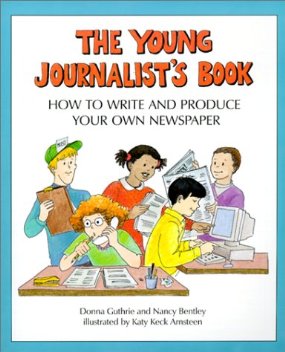
514J0T38H9L._SX285_Young Journalist’s Book: How to Write and Produce Your Own Newspaper, is a great place to help children begin learn the difference between good and bad journalism.
The book is a step-by-step guide that explains what a journalist does, what makes an interesting story, and how newspapers differ from books. Students learn about gathering facts, writing a story, proofreading, designing layout, printing, and distributing their newspaper. There are frequent references to using computers in the process. The authors describe the different types of stories, e.g., news, features, and editorials, with hints on how to write each one and suggestions for topics. This title is similar in format to Guthrie and Bentley’s The Young Author’s Do-It Yourself Book (1994) and The Young Producer’s Video Book (1995, both Millbrook). The full-color cartoons are appealing. Inspirational, practical fare for writers and would-be reporters.-Marion F. Gallivan, Gannon University, Erie, PA
E How talks about the steps to establishing a newspaper at your elementary school. They include:
Brainstorm possible newspaper names and story ideas with your newspaper staff. Articles can be about school-wide news, book reviews, movie reviews and more.

Assign articles to your students. Warn them about the dangers of plagiarism and explain the term to your students. Provide them with a deadline for their articles. Make the deadline reasonable. Since they are elementary school students, they will probably need at least a couple of weeks to complete their articles.

Decide whether you will type the articles into a word processing document or whether you will leave this task up to your staff. Some students know how to type quickly while others haven’t learned keyboarding yet. Be sure you run spell check and proofread the articles.

Pocatello School Demonstrates Keys for Better Reading and Writing

9780439696494_p0_v1_s260x420This is a repost of an article I wrote in 2006 that appeared in the Idaho State Journal.

I was recently inspired by a day of substitute teaching at the Pocatello Community Charter School. That morning in the parking lot, I ran into Marjanna Hulet, one of the school’s founders, as I made my way to the office.
__
What are you doing here? she said. Marjanna, who visits the school regularly, is demonstrating the spirit of inquiry this sunny morning, I thought to myself.

After a tour of the facility for myself, my wife, and our daughters, my thinking moved toward the elements that make popular schools like this one so beneficial for children.

I was recently inspired by a day of substitute teaching at the Pocatello Community Charter School. That morning in the parking lot, I ran into Marjanna Hulet, one of the school’s founders, as I made my way to the office.
-
What are you doing here? she said. Marjanna, who visits the school regularly, is demonstrating the spirit of inquiry this sunny morning, I thought to myself. After a tour of the facility for myself, my wife, and our daughters, my thinking moved toward the elements that make popular schools like this one so beneficial for children. What is the single most important approach to teaching that makes a difference in how well learners succeed? In the book “Classroom Discourse: The Language of Teaching and Learning,” Courtney Cazden defines this key strategy as scaffolded instruction.
-
Scaffolding, she says, is the process in which the learner participates in the full performance of a given activity to the degree to which he or she is capable. The adult provides the “helping hand.” As the learner gains competence, the teacher gradually increases expectations of how much of the full performance the child can be responsible for. When teachers scaffold students’ learning, they begin by exposing children to the task through modeling and providing examples. Gradually, students are invited to take part in the process although minimally at first. Students may work with partners or in small groups as they take more and more responsibility for the task. They are helped to solve problems and to focus on specific strategies related to what they are learning while gaining competence in the task.

Gradually, they move toward independence, applying what they know to similar but new situations. With independence, students are guided to think and talk about what they are now able to do.
Below is a summary of the process of applying strategic scaffolding to writing in a particular form, such as a memoir or poetry. At the Pocatello Community Charter School, I was able to participate in Whitney Griggs’ early elementary multiage classroom, where we engaged students in many similar strategies, from writing together to writing alone.

Griggs began with Immersion and then Exploration. During Immersion, students are exposed to the forms under study as they listen and respond to examples read aloud and share examples they discover on their own. Throughout the sharing, students are encouraged to notice patterns and similarities and to decide what makes this particular form unique.

They observe, reflect, and discuss. This exploration of the form helps students crystallize their ideas. Experimentation begins with the teacher modeling the form as a “think aloud” demonstration for the children. During a think-aloud, the teacher actually writes while saying aloud everything that is going on inside his or her head: “I think I’ll choose rain as my topic. When I think of rain, I think of wet, soggy, shiny. It cleans the streets,” and so on. The teacher generates ideas, organizes and changes them out loud as if the children were not present.

Think alouds are useful because they provide a window into how a skilled writer thinks and what the teacher is eventually going to ask students to do on their own.

“We strive to create a culture of quality at the Pocatello Community Charter School,” said Dr. Martha B. Martin, the school’s dean. “Since we have a portfolio assessment system at this school, we have a lot of conversations about ‘portfolio quality.’ Our crew leaders have to teach children what quality is, and we do this through modeling and the use of exemplars.”

“Students begin to understand that if they are going to do something, they should do it well,” Martin continued. “They begin to recognize signs of quality in their own work and that of their classmates. When you create a culture of quality at school, members of that learning community are able to critique each other’s work and help one another revise and edit. The process is slow, messy and cumbersome, but the result is portfolio quality products that help children understand what they are truly capable of creating.”
Writing articles like this one helps me to reflect and analyze inquiries such as Marjanna Hulet’s “what are you doing here?” at the Pocatello Community Charter School. There, I am experiencing the thrill of teaching and learning in an atmosphere that is truly empowering for young people.

Finding Joy in the The Pythagorean Theorem

Read this article  on Daily Kos from Mar. 18 2012
Read this article on the Idaho Press Tribune website from Mar. 22, 2012
Read this article on Yahoo! from March 26, 2012

Pythagorean Theorem may be the best-known equation in mathematics. Its origins reach back to the beginnings of civilization, and today every student continues to study it. What most nonmathematicians don’t understand or appreciate is why this simply stated theorem has fascinated countless generations.

9781616141813_p0_v2_s260x420I first met Alfred S. Posamentier in 2001, when he was the Dean of Education at City College in New York. The energy level of his intellectual engagement with my work is part of an experience I will never forget.

In his entertaining and informative book, The Pythagorean Theorem: The Story of Its Power and Beauty , Posamentier, a veteran math educator, makes the importance of the Pythagorean theorem delightfully clear.

The Pythagorean theorem has attracted interest outside mathematics as a symbol of mathematical abstruseness, mystique, or intellectual power. Scores of references to it can be found in literature, plays, musicals, songs, stamps and cartoons. It can be introduced to students during the middle school years and becomes increasingly important during high school. It is not enough to merely state the algebraic formula for the Pythagorean Theorem.

According to University of Georgia graduate student Stephanie Morris:

Students need to see the geometric connections as well. The teaching and learning of the Pythagorean Theorem can be enriched and enhanced through the use of dot paper, geoboards, paper folding, and computer technology, as well as many other instructional materials.

The Pythagorean theorem or Pythagoras’ theorem is a relation in Euclidean geometry among the three sides of a right triangle (right-angled triangle). In terms of areas, it states:

In any right triangle, the area of the square whose side is the hypotenuse (the side opposite the right angle) is equal to the sum of the areas of the squares whose sides are the two legs (the two sides that meet at a right angle).
The theorem can be written as an equation relating the lengths of the sides a, b and c, often called the Pythagorean equation:  a^2 + b^2 = c^2\!\,  where c represents the length of the hypotenuse, and a and b represent the lengths of the other two sides.

The theorem is named after the Greek mathematician Pythagoras, who by tradition (only) is credited with its discovery and proof. The theorem has numerous proofs, possibly the most of any mathematical theorem. These are very diverse, including both geometric proofs and algebraic proofs, with some dating back
 thousands of years. The theorem can be generalized in various ways, including higher-dimensional spaces, to spaces that are not Euclidean, to objects that are not right triangles, and indeed, to objects that are not triangles at all, but n-dimensional solids.

Posamentier begins his book with a brief history of Pythagoras and the early use of his theorem by the ancient Egyptians, Babylonians, Indians, and Chinese, who used it intuitively long before Pythagoras’s name was attached to it.

He then shows the many ingenious ways in which the theorem has been proved visually using highly imaginative diagrams. Some of these go back to ancient mathematicians; others are comparatively recent proofs, including one by the twentieth president of the United States, James A. Garfield.

After demonstrating some curious applications of the theorem, Posamentier then explores the Pythagorean triples, pointing out the many hidden surprises of the three numbers that can represent the sides of the right triangle (e.g, 3, 4, 5 and 5, 12, 13). And many will truly amaze the reader.

Next, Posamentier turns to the “Pythagorean means” (the arithmetic, geometric, and harmonic means). By comparing their magnitudes in a variety of ways, he gives the reader a true appreciation for these mathematical concepts.

The final two chapters view the Pythagorean theorem from an artistic point of view–namely, how Pythagoras’s work manifests itself in music and how the Pythagorean theorem can influence fractals.
This lucid presentation and gift for conveying the significance of this key equation to those with little math background will inform, entertain, and inspire the reader, once again demonstrating the power and beauty of mathematics!
A Model School: Coyote Ridge Elementary

This is a repost of an article originally published in The Post Register in July 2006.
“My author visits in the Roseville/Antelope area were most enjoyable.”
—
Teachers need to model effective learning behaviors. Students examine the instructor, then learn and grow through reflection, imitation, and interpretation. As with human beings, schools also can be held up as role models.

Since the ideas presented in my last TalkBack, about school newsletters, prompted numerous responses from grateful and concerned educators wanting to hear more, I’ve decided to highlight a model school. The goal here is to enhance the many good practices that are already being implemented inlocal classrooms.
Coyote Ridge Elementary is one of California’s Distinguised Schools. I worked closely with it’s principal, Michelle Harmeier, a few years ago while performing author visits in the Dry Creek Joint Elementary District. The district lies in the suburban Roseville/Antelope area of northern SacramentoCounty, and southern Placer County.

Coyote Ridge is a school with a vision. Strong partnerships between students, parents, staff, and the community enrich the core curriculum program.

Program highlights for last school year include: improving academic achievement in the areas of English/Language Arts and Math; enhancing co- curricular and enrichment programs; building assets in students and staff; and implementing an Accelerated Reader program.
9781935249511_p0_v1_s260x420What Effective Schools Do is designed as guide to assist educators with activities for implementing a continuous school improvement system through application of the seven correlates of effective schools: 1. High expectations for success 2. Strong instructional leadership 3. A clear and focused mission 4. Opportunity to learn/time on task 5. Frequent monitoring of student progress 6. Safe and orderly environment 7. Positive home-school relations The ten chapters provide a comprehensive description of practices that enable educators to build and sustain a school culture that accommodates the learning expectations and needs of all students. The correlates of effective schools represent the knowledge educators need to successfully teach all children. Taken together, the correlates are more than just theory; they are what effective schools do.
Reading practice quizzes are the foundation of the Accelerated Reader program. They help teachers measure students’ comprehension of books they read independently, with an adult, or have read to them. The objective of this program is to help teachers motivate and monitor reading practice. They ensure a successful, positive experience if the student has read a book at the proper reading level.

The district’s web site includes a School Calendar, a , an Accelerated Reader Book List, and an Accelerated Reader Book Level List, for Coyote Ridge Elementary.

My author visits in the Roseville/Antelope area were most enjoyable. Harmeier acted as a liason for four schools, and I visited one each day. The students engaged in whole group readings and Q & A sessions with me, followed by breakouts with small groups in the different grades. In the individual classrooms, I heard and critiqued student creative writing. After I left, teachers had me interact with different classes as students wrote in questions and posted their material on my children’s literature and literacy website.

Such author visits, literature studies, and book discussions can be used to help students deepen their understanding of their own cultural backgrounds, as they connect to the backgrounds of others. Students and their families learn that people like themselves are found in print. Making sense of print takes on a new dimension for all involved.

Such partnerships are also going on in Idaho Falls. Brian Arave, Director Community and Foundation Relations for School District 91, deserves special thanks for his enthusiastic outreach. My family looks forward to many more meaningful experiences as the school year begins.

THE MIGHTY LALOUCHE: A charming tale by Matthew Olshan that holds a few surprises between its pages

mighty-laloucheOne hundred and a few-odd years ago, in Paris, France, there lived a humble postman named Lalouche. He was small, but his hands were nimble, his legs were fast, and his arms were strong. In THE MIGHTY LALOUCHE, the extraordinary happens when Monsieur Lalouche takes to the ring and proves himself a boxer extraordinaire. “C’est impossible!”  you say? This charming tale by Matthew Olshan, illustrated by New York Times Best Illustrated Award winner Sophie Blackall, holds a few surprises between its pages.
__
 
Lalouche is an endearingly oddball hero, and Blackall takes her always-exquisite
ink-and-watercolor artwork to another level. . . . C’est formidable!”
—Publishers Weekly, Starred
 
When his job is replaced by an electric car, the postman Lalouche turns to boxing to support himself and his pet finch, Genevieve. But—“You? A boxer?” the fighters ask. “I could sneeze and knock you down!” Still, Lalouche refuses to give up. Weathering such threats as “I’ll zap him,” “I’ll tie him in a pretty bow,” and, most alarmingly, “I’ll squeeze him till he pops!” Lalouche nimbly thwarts each of his frightening foes in the ring, proving that size is no indicator of strength or will.
 
This marvelous story, full of humor and heart, salutes the unlikely champions who remind young readers that creativity and wit trump brute force. As the plot unfolds in Paris, France, in the early 1900s, readers are treated to historical details, heightened by Blackall’s clever, kid-friendly art. In keeping with the historical nature of the story, Blackall uses the nearly forgotten Japanese paper diorama art style called tatebanko for this book to stunning effect.
__
“The illustrations are outstanding–Blackall has outdone herself. . . .
The text and pictures work expertly together.”
—School Library Journal, Starred
 
was written specifically for Sophie Blackall after Matthew Olshan discovered that she collected old pictures of boxers, especially “extremely skinny ones with big billowing boxing trunks.”
 
MATTHEW OLSHAN is the author of Finn: A Novel, a modern telling of Mark Twain’s The Adventures of Huckleberry Finn, with girls as protagonists rather than boys. His latest novel, The Flown Sky, is a fantasy in the tradition of C. S. Lewis’s Narnia Chronicles. Olshan lives in Baltimore, but also has a little farm in south central Pennsylvania, called Pencil Creek.
 
SOPHIE BLACKALL received the New York Times Best Illustrated Award for her book Big Red Lollipop, and won the Ezra Jack Keats Award for New Talent. She is the illustrator of Meet Wild Boars, a Bulletin Blue Ribbon Book; Jumpy Jack & Googily; What’s So Bad About Being an Only Child?; Summer Is Summer; Edwin Speaks Up; and others. A native of Australia, she lives in Brooklyn, New York.

Made Me a Story … Still Got It


9780060091248When I am working with children in schools, I always remind them that one of the great things about writing is that it always stays with you.

The poem Things by Eloise Greenfied summarizes the feeling:
It includes the words:

Bought me some candy  …
Ain’t got it no more
… Made me a poem
Still got it

Click here for the full text of the poem.

So what a joy it was to find this heartwarming story that I wrote back in 1992 when I was working as a reporter for The Morning Call in Allentown, PA.
February 21, 1992 | by MICHAEL R. STRICKLAND, The Morning Call
Ten wheelchair-bound people last night were rolled up a closed-off St. John Street on their way to hear songs, jokes and words of inspiration at a service that honored three people who had made a major contribution to bettering their lives. The procession went from Good Shepherd to Grace Lutheran Church of Allentown.

The Rev. Daniel G. Gambet, president of Allentown College of St. Francis de Sales, quoted Mother Theresa, saying, “Electric wire is useless unless the current passes through it and lights up the world,” at the seventh annual Raker Memorial Award Service, named for the founders of Good Shepherd. … Gilbert E. Castree, a 78-year-old resident of Allentown, said his 15 years as a member of Good Shepherd’s board of trustees have been the best of his life. Stricken with polio, meningitis and pneumonia all at age 9, Castree gave testimony to the human spirit by going from being handicapped to playing high school football.
“The feeling you get volunteering here is unlike the feeling you get anywhere else,” Castree said. “The many years have meant more to me than I could ever express.”
Read: Good Shepherd Bestows Honors On Three Who Made Difference
Hat Tip to The Morning Call for keeping their archives public, going back so many years.

And I remind young learners that “even when archives are no longer there, your story always is.”

___
See this recent related article on the topic of faith in the public square, from the Idaho State Journal.

How interactive technology is changing the classroom and our children


If you walk into most classrooms in the UK today, you will soon notice the big screen in the middle of the room at the front.

It’s not a television or movie screen, but an interactive whiteboard, and it can be used for many activities within the classroom enabling the teachers and students to present, share, interact and most importantly collaborate with each other. The board itself connects to a computer and a projector, displaying whatever is on the computer screen.

When this technology first appeared in the UK in the late 1990′s it was referred to as an electronic blackboard, and, at a very low level, some are still used in this way.

Read the full story.
virtual-child-cover-bigHere is an alternative viewpoint: Virtual Child: The terrifying truth about what technology is doing to children
Children now use an average 8 hours per day of entertainment technology with profound impact on their physical, mental, social and academic development. One third of North American children enter school developmentally delayed, and child obesity is now a national epidemic. One in six children has a diagnosed mental illness, with child aggression and unmanageable behaviour increasingly the norm. One in six children cannot pay attention and require learning assistance. With research now showing causal links between physical, mental, social and academic disorders in children who overuse technology, schools and homes continue to escalate unrestricted use. Virtual Child offers parents, health and education professionals innovative tools and techniques to enhance child development and academic performance, while managing balanced use of technology. Modifications to home and school structure and environment, serve to ensure that every new millennium child will achieve a healthy, productive and sustainable future.
Author Chris Rowan is a frequent guest on CBC public radio and featured on CBC TV’s Doc Zone, Cris Rowan is known world-wide as a child development expert in the area of technology’s effects on children. As CEO of Zone’in Programs Inc. Cris Rowan has developed a ‘System of Solutions’ to address the issues of technology overuse by children. Zone’in Products, Workshops, Training and Consultation services are widely used and respected by parents, as well as health and education professionals in health units, child development centers, schools, clinic and hospital based settings. Zone’in Products include Zone’in, Move’in, Unplug’in and Live’in educational programs to enhance child health and academic performance. Zone’in Foundation Series Workshop topics include sensory processing, motor development, attachment and addictions, technology overuse, attention and learning, productivity school design, and early intervention. Zone’in Training certifies pediatric occupational therapists as Foundation Series Workshop instructors. Zone’in Consultation services provide education and training to promote Balanced Technology Management initiatives in home, school and community settings.

Rowan recently developed the Balanced Technology Management (BTM) concept which promotes managing balance between activities children need for growth and success with technology use, and has created BTM initiatives for six target groups: parents, teachers, health professionals, government, researchers and technology production corporations.

Rowan is a prolific writer and has published numerous articles on sensory and motor development, printing literacy, attachment, addictions, attention, learning, and the impact of technology on child development. Rowan authors a monthly Development Series newsletter with a readership of over 40,000 parents, health and education professionals. Rowan has authored the following policy initiatives Unplug – Don’t Drug: Routine Technology Screening Prior to Behavior Diagnosis and Medication, Schools Operating Safely – Child Behavior Management Policy and Procedures, Creating Sustainable Futures for Children of the New Millennium, and Linking Corporations to Communities – Technology Production Corporate Funding Opportunities for Schools and Communities.

Related Reading: The iQRite Touch Frame is the world’s first kitset touch frame designed for a wide range of applications and any surface or digital display technology.